


Are you investing in SEO and paid ads but still not seeing the leads you expect? Your website might be attracting visitors, but if they aren't taking action—like making a purchase, requesting a quote, or picking up the phone—your marketing budget is effectively leaking. This is where Conversion Rate Optimisation (CRO) becomes a game-changer.
CRO is the systematic process of refining your website to increase the percentage of visitors who become customers. It’s not about getting more traffic; it’s about converting the traffic you already have. For Australian SMBs, professional services, and trades, a well-executed CRO strategy is the key to unlocking sustainable growth, improving operational efficiency, and maximising the return on every marketing dollar spent. At DigitUX, we see this as a core component of a successful digital transformation.
What Is CRO and Why It Matters for Australian Businesses
Imagine your website is a physical storefront. Your SEO and advertising efforts are like signs and flyers that bring people to your door. But if customers walk in and find the layout confusing, the checkout process complicated, or can't find anyone to help them, they'll leave without buying anything. That's a lost opportunity.
CRO is the art and science of perfecting that in-store experience online. It plugs the leaks in your "digital bucket," ensuring the visitors you worked so hard to attract don't slip away. By analysing user behaviour and making data-driven improvements, you can guide more visitors toward a valuable action, such as:
Making a purchase
Filling out a contact form
Subscribing to a newsletter
Requesting a quote
This strategic approach turns your website from a passive brochure into an active, automated lead generation engine, directly contributing to your bottom line.

The Growing Demand for CRO in Australia
This focus on efficiency and performance is no longer a niche tactic; it's a fundamental shift in how smart Australian businesses scale. The data confirms this trend, with Google Trends showing a steady, decade-long increase in searches for "conversion rate optimisation" in Australia.
What was once a specialist discipline is now a core pillar of modern digital strategy for growth-focused Australian companies.
Key Takeaway: Ignoring CRO means you are actively leaving money on the table. Every visitor who leaves your site without converting is a missed opportunity and a wasted chunk of your marketing budget.
The numbers are compelling. Interest in 'conversion rate optimisation' has surged by nearly 500% since 2012. More importantly, businesses that consistently run on-site experiments like A/B testing see an average conversion rate lift of around 14%. Some individual tests have been known to boost conversions by as much as 49%. You can discover more insights on these CRO statistics to see the impact for yourself.
More Than Just Clicks and Traffic
For Australian professional services and trades businesses, a 'conversion' isn't just an online sale—it’s a qualified lead. It's a phone call from a potential client who found your services page clear and compelling. It’s a quote request from a customer convinced by your project gallery and testimonials.
At DigitUX, we integrate CRO into a broader digital transformation framework. It’s the critical link connecting your SEO, AEO (Answer Engine Optimisation), and performance marketing efforts to real business outcomes. This ensures your online visibility translates directly into measurable growth, improved efficiency, and a stronger bottom line.
Understanding Australian Conversion Benchmarks
Before you can improve your website's performance, you need a realistic starting point. What does a 'good' conversion rate actually look like for your business?
Comparing your results to generic global averages is misleading. An electrician in Melbourne operates in a different market to a software company in San Francisco. To set meaningful goals for
conversion rate optimisation in Australia
, you need Australian benchmarks. This local context allows you to gauge your performance accurately, identify genuine growth opportunities, and build a strategy that delivers results in your market.
The Current State of Conversions in Australia
The Australian digital landscape is shaped by unique consumer behaviours, economic factors, and industry maturity. Understanding these nuances provides a baseline for your own website's performance.
Recent data shows the average e-commerce conversion rate in Australia is 1.78%, slightly below the global figure. However, the service industry tells a more promising story, converting at an impressive 3.3% on average. This highlights a key opportunity for trades and professional services: Australian consumers are actively using websites to find and engage local providers. You can explore these Australian marketing statistics and trends for a deeper dive.
Industry-Specific Benchmarks for Aussie Businesses
A "good" conversion rate varies significantly between industries. A high-value B2B service will naturally have a different conversion journey—and rate—compared to a local retail business. This is why sector-specific data is vital.
Here’s a breakdown of average conversion rates across key Australian industries. Use this as a more relevant yardstick for your own business.
Australian Conversion Rate Benchmarks by Industry
This table compares average conversion rates across key industries in Australia, helping businesses benchmark their performance within their specific sector.
| Industry Sector | Average Conversion Rate (%) |
|---|---|
| B2B Services | 12.3% |
| Professional Services | ~3.3% |
| Trades & Construction | ~3.3% |
| E-commerce (Retail) | 1.78% |
These figures are insightful. The high B2B rate reflects the value of a single lead and the motivated nature of the buyer. For trades and professional services, a solid 3.3% demonstrates that clear service pages and simple contact forms are highly effective. The lower e-commerce rate underscores the competitive nature of online retail, where every step of the customer journey must be seamless.
Key Insight: Your industry defines your benchmark. A trade business aiming for a 1.78% e-commerce rate is setting the bar way too low, while an online store celebrating a 3% rate is absolutely knocking it out of the park.
Moving Beyond the Averages
While benchmarks provide a valuable starting point, they are not the finish line. They represent the average performance, which includes countless unoptimised, clunky websites.
The real opportunity lies in surpassing these averages by systematically improving your user experience. Your CRO journey begins with understanding where you stand today. Use these figures to see how you compare, but make it your mission to outperform them. A data-driven approach—analysing user behaviour, testing changes, and continually refining your site—can transform an average website into a powerful conversion engine that drives consistent growth for your Australian business.
A Practical Framework for CRO Success
Knowing your benchmarks is the first step, but turning that insight into measurable growth requires a structured process. Effective conversion rate optimisation for Australian businesses isn't about guesswork or randomly changing button colours; it's a disciplined cycle of diagnosing problems, testing solutions, and iterating based on data.
We use a simple, three-phase framework designed for busy business owners: Audit, Test, and Iterate. This method cuts through the noise, turning complex data into a clear action plan and ensuring every change is deliberate and evidence-based.
This infographic provides a snapshot of average conversion rates across key Australian industries, showing where your business might fit.
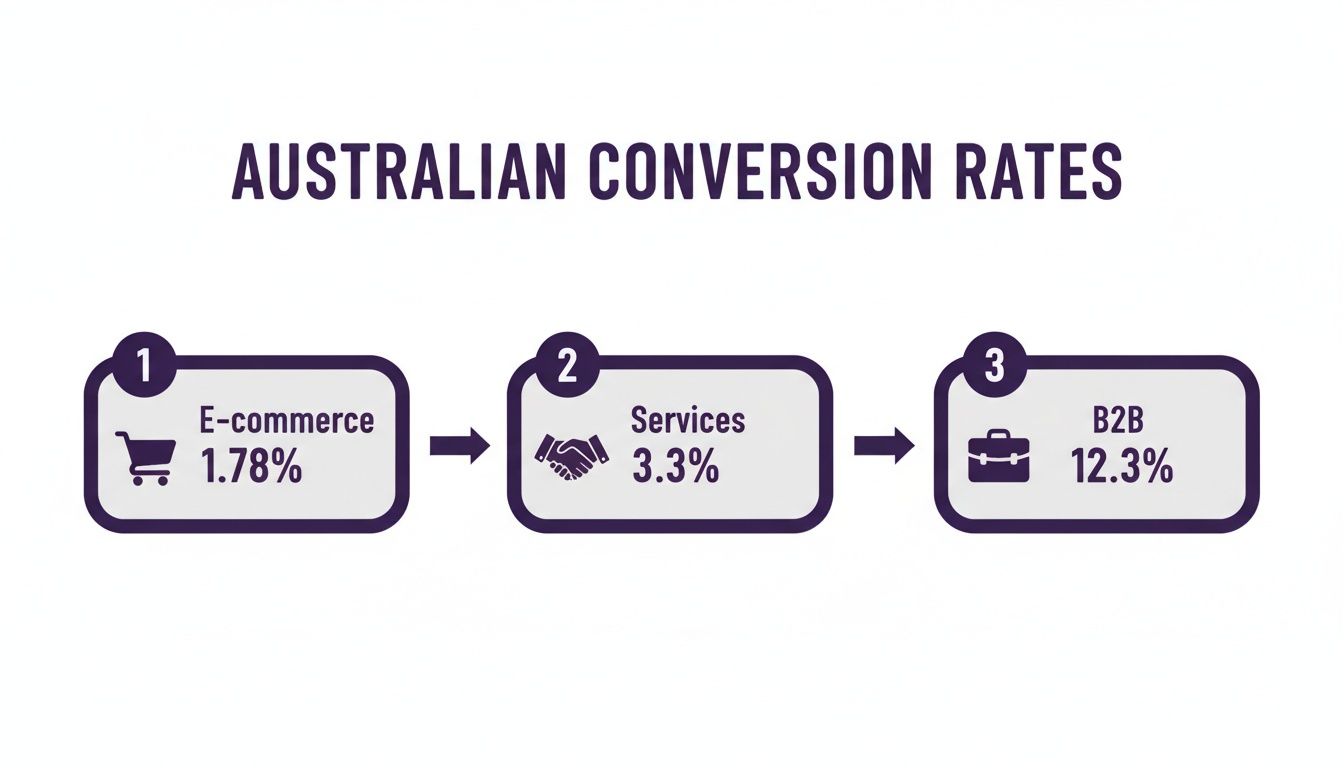
It’s clear that Australian B2B and service-based businesses often convert at a higher rate than e-commerce sites, emphasising the importance of a frictionless lead generation process for these sectors.
Phase 1: Audit and Analyse
Think of this phase as a "Digital Health Check" for your website. The goal is to move beyond your overall conversion rate and uncover why users behave the way they do. You need to identify the exact friction points where potential customers get frustrated, confused, or simply abandon their journey.
To do this effectively, you need the right tools:
Website Analytics (e.g., Google Analytics 4): This is your source for hard data. Look for high-traffic pages with high exit rates, or pinpoint the specific step in your contact form where most users drop off.
Heatmaps and Scroll Maps: Tools like Hotjar or Microsoft Clarity provide a visual story. Heatmaps show what users click on (and what they ignore), while scroll maps reveal how far down a page they scroll. This is an excellent way to see if your most important content is being seen.
User Session Recordings: These are anonymised videos of real user sessions on your site. Watching a few can be an eye-opening experience, quickly revealing usability issues and points of friction you might never have noticed yourself.
Key Takeaway: The audit phase is about gathering evidence. Your goal is to pinpoint specific friction points—like a confusing navigation menu on mobile or a quote form that asks for too much information—and support your findings with data.
A significant part of any CRO strategy is user experience. A practical framework for success must include how to implement effective user experience optimisation, as this ensures your changes genuinely help your visitors.
Phase 2: Hypothesise and Test
Once you’ve gathered evidence, you can shift from diagnosing problems to proposing solutions. This involves turning your insights into testable hypotheses—specific, measurable "what if" statements that can be proven or disproven with data.
A strong hypothesis isn't vague like "let's improve the homepage." It's precise: "By changing our services page headline from 'Quality You Can Trust' to '24/7 Emergency Service in Sydney', we predict quote requests will increase by 15% because it directly addresses our target customer's urgent need."
The gold standard for validating a hypothesis is A/B testing (or split testing).
The concept is straightforward: you create two versions of a webpage. Version 'A' is the original (the control), and version 'B' is the new version with your proposed change (the variation). You then split your website traffic between the two. After enough time to gather a reliable result, you can see with statistical certainty which version performed better. Our guide explains why you need to start A/B testing now to achieve meaningful gains.
Phase 3: Implement and Iterate
The final phase involves acting on your results and fostering a culture of continuous improvement. When a test produces a clear winner, the first step is to implement that change permanently on your live website.
But the work doesn't end there. True CRO is an ongoing cycle, not a one-off project. The learnings from one test often spark new questions and ideas for the next. For example, after a successful headline test, you might ask, "That worked. Now, what if we also changed the call-to-action button to match the new headline's urgency?"
This iterative approach creates a powerful feedback loop:
Analyse: Identify a problem on your site.
Hypothesise: Form an educated guess on how to fix it.
Test: Run an A/B test to prove or disprove your hypothesis.
Implement: Roll out the winning variation.
Repeat: Use your learnings to identify the next opportunity.
By adhering to this structured framework, you remove guesswork and personal opinion from the website improvement process. Every decision is backed by data, leading to steady, compounding gains that transform your site from an online brochure into a highly effective lead-generation asset.
Building Your Essential CRO Toolkit
Smart, data-driven decisions are at the heart of CRO. You don't need a huge budget or a complex suite of software to start with conversion rate optimisation in Australia. The key is to build a practical toolkit that delivers clear insights without creating unnecessary complexity.
For most Australian SMBs, a solid CRO tech stack only needs to cover three core functions: understanding your analytics, observing user behaviour, and testing your hypotheses. Mastering these provides a complete picture of what’s happening on your website and, more importantly, why.
Foundational Analytics Tools
Before you can improve anything, you need a clear baseline. Analytics platforms are your source of truth, revealing everything from traffic sources and user demographics to where your sales funnels are leaking potential customers.
Google Analytics 4 (GA4): This is non-negotiable for any Australian business with a website. It’s free, powerful, and the industry standard for tracking where visitors come from, what they do, and where they leave. Setting up conversion goals in GA4 is the first step toward measuring what truly matters.
Google Search Console: While primarily an SEO tool, Search Console is a goldmine for CRO. It shows you the exact search queries that bring people to your site, helping you align your page content and headlines with actual customer intent—a critical piece of the conversion puzzle.
Behavioural and User Experience Tools
Analytics tells you what is happening; these tools show you why. They provide a visual, over-the-shoulder look at the user journey, helping you identify friction points that quantitative data alone can't reveal. A seamless user journey is critical, and you can learn more about how to improve online user experience and increase conversions in our detailed guide.
Key Takeaway: Watching just a handful of user session recordings can be more insightful than hours spent in spreadsheets. It’s the fastest way to build empathy for your customers and see your website through their eyes.
Microsoft Clarity: An outstanding free tool from Microsoft. It provides heatmaps (to see where users click), scroll maps (to see how far down they go), and session recordings (anonymous videos of user visits). It is perfect for diagnosing why users aren't completing your contact form or are abandoning their cart.
Hotjar: One of the most popular and user-friendly behavioural analytics tools. Hotjar offers similar features to Clarity but also makes it easy to gather direct user feedback through on-site polls and surveys. It's a fantastic all-in-one solution.
Testing and Experimentation Platforms
Once your data has helped you form a hypothesis for an improvement, you need a way to test it scientifically. A/B testing platforms allow you to show different versions of a page to different segments of your audience and measure which one performs better.
Google Optimise
: While Google is sunsetting this as a standalone product, its A/B testing features are being integrated into GA4. This makes Google's ecosystem a great, no-cost starting point for running basic experiments.
VWO (Visual Website Optimizer): For businesses ready to invest in a dedicated platform, VWO is an excellent paid tool that simplifies A/B testing. Its user-friendly visual editor allows you to make changes and run tests without needing a developer for every minor adjustment.
Core CRO Tool Comparison for Australian SMBs
Choosing the right tools can feel overwhelming. This table breaks down the essentials to help you build a stack that fits your business needs and budget.
| Tool Category | Recommended Tool | Primary Use Case | Best For |
|---|---|---|---|
| Web Analytics | Google Analytics 4 (GA4) | Tracking traffic, user behaviour, and conversions. | Every business. It’s the foundational, non-negotiable data source. |
| Behavioural Insights | Microsoft Clarity | Watching session recordings and viewing heatmaps. | SMBs on a budget wanting to quickly find and fix usability issues. |
| Behavioural Insights | Hotjar | Combining heatmaps with on-site polls and feedback. | Businesses wanting an all-in-one tool for visual data and direct user feedback. |
| A/B Testing | VWO | Running controlled experiments to validate changes. | Teams ready to invest in a dedicated, easy-to-use testing platform. |
By combining a tool from each category, you move beyond guesswork. This balanced toolkit gives any Australian SMB the power to launch a structured CRO program and start making changes that deliver measurable business growth.
CRO and Australian Consumer Law
When discussing conversion rate optimisation in Australia, it's easy to focus on design and A/B testing. However, the true foundation of effective CRO isn't just psychology—it's trust. And nothing builds trust more effectively than operating transparently and ethically within Australian law.
Ignoring your legal obligations is not just risky; it's bad for business. For any Australian company, two pieces of legislation are paramount: the Australian Consumer Law (ACL) and the Privacy Act, which includes the Australian Privacy Principles (APPs). These aren't just legal hurdles; they are a framework for creating a trustworthy experience that encourages conversions.
Navigating Transparency and Data Collection
Modern CRO relies on data to personalise the user experience. However, the Australian Privacy Principles (APPs) are clear: you must be transparent about what data you collect and why.
Key Insight: Clear data usage policies are a conversion opportunity. A simple privacy policy and clear cookie consent notices demonstrate respect for your customers, which is the cornerstone of the trust required for them to convert.
This means no pre-ticked consent boxes for marketing communications and ensuring your privacy policy is easy to find and understand. If you use tools like heatmaps or session recorders, your policy should explain that you are gathering behavioural data to improve the website experience. This transparency fosters a sense of security that Australian consumers value.
Honesty in Advertising and Claims
The Australian Consumer Law (ACL) has a zero-tolerance policy for misleading and deceptive conduct. Every claim on your website—from "Best Plumber in Brisbane" to a "50% Off Sale"—must be truthful, accurate, and verifiable.
Fake testimonials, ambiguous pricing, or exaggerated service claims can damage your reputation and lead to regulatory action. Your CRO efforts must adhere to these rules. When testing new headlines or value propositions, ensure they remain truthful.
Misleading: "Guaranteed #1 Google Ranking" (This cannot be guaranteed).
Honest & Better: "Proven SEO Strategies to Help You Rank Higher" (This is a factual claim about your service, not a false promise).
The same principle applies to urgency tactics. If you use countdown timers or stock level indicators, they must be genuine. A timer that resets on every page refresh is a deceptive practice under the ACL and a fast way to lose a customer's trust.
Building Credibility with Local Trust Signals
Beyond legal compliance, you can build significant credibility by demonstrating that you are a legitimate Australian business. Savvy local consumers look for specific trust signals that confirm your accountability.
Integrate these elements into your website to put visitors at ease:
Display Your ABN: Your Australian Business Number should be clearly visible, typically in the footer.
Provide Clear Contact Details: A phone number and a physical address should be easy to find.
Showcase Local Payment Options: Featuring trusted gateways like Afterpay or Zip shows you are set up for the Australian market.
By embedding these legal and ethical practices into your CRO framework, you do more than avoid penalties. You create a secure, transparent, and trustworthy environment that gives Australian consumers the confidence they need to become customers.
Your Quick-Win CRO Checklist

Ready to get more leads from your website today? You don’t need a massive budget or a complex testing plan to get started. This practical checklist is built for busy Australian service and trade businesses, zeroing in on high-impact tweaks you can make right now.
Think of these quick wins as plugging the biggest leaks in your sales funnel. By fixing these common friction points, you stop losing potential customers and build a solid foundation for more advanced conversion rate optimisation in Australia.
Sharpen Your Homepage and Service Pages
Your homepage and service pages are your digital storefront. Their primary job is to instantly communicate to a visitor, "Yes, you're in the right place." Your goals are clarity, trust, and a clear path to action.
Craft a Compelling Value Proposition: Can a first-time visitor understand what you do, who you serve, and why you're the best choice within five seconds? Replace vague marketing speak like "Quality Solutions" with direct, benefit-driven language like "24/7 Emergency Plumber for Brisbane Homeowners."
Showcase Authentic Social Proof: Nothing builds trust faster than seeing that other Australians have had a positive experience. Display testimonials from real clients, including their names and locations where possible. Industry awards, case studies, and logos of businesses you’ve served are also powerful trust signals.
Make Your Call-to-Action (CTA) Unmistakable: Use strong, action-oriented text on your buttons. "Request a Free Quote" is far more persuasive than a generic "Submit." Ensure your CTAs are visually prominent with a colour that stands out from the rest of the page.
These pages are often the first point of contact with a new customer. To make them truly effective, it's essential to understand the principles of building landing pages that maximise conversions.
Streamline Your Contact and Quote Forms
A long, complicated form is a conversion killer. The easier you make it for someone to contact you, the more leads you will generate.
Key Takeaway: Every additional field in a form is another reason for a user to abandon it. Your goal should be to ask for the bare minimum information needed to initiate a conversation.
Remove Unnecessary Fields: Do you really need a prospect's ABN or company name for an initial enquiry? Probably not. Stick to the essentials: Name, Email, Phone, and a message box.
Set Clear Expectations: If you typically respond within 24 hours, state this next to the form. This simple reassurance can significantly boost submission rates.
Optimise for Mobile Users
A significant portion of your visitors, especially for local trades and services, will find you on their smartphones. If your site is difficult to use on a mobile device, you are actively turning away customers.
Test Your Mobile Experience: Don't just assume your site is mobile-friendly. Use your own phone to navigate your website. Can you easily tap the menu buttons? Is the text readable without zooming?
Enable Click-to-Call: This is non-negotiable. Ensure every phone number on your site is a clickable link on mobile devices. This small change makes it incredibly easy for a customer to contact you instantly.
Common Questions About Conversion Rate Optimisation
Let's address some of the most common questions Australian small businesses have about CRO. Clarifying these points will give you the confidence to begin optimising your site.
How Much Traffic Do I Need to Start CRO?
While there's no single magic number, a general rule of thumb is to have at least 1,000 monthly visitors to a specific page before running formal A/B tests. With less traffic, it's difficult to achieve statistically significant results in a reasonable timeframe.
However, low traffic shouldn't stop you from applying CRO principles. You can still use qualitative data from heatmaps, session recordings, and customer feedback to make informed improvements without a formal split test.
What Is a Realistic Improvement for a Small Business?
This varies by industry, but it's realistic for an Australian SMB to aim for an initial 10-20% lift in conversions by addressing foundational issues like broken forms, confusing navigation, or a weak call-to-action.
The real power of CRO, however, lies in consistent, incremental wins. A small 0.5% increase in your conversion rate may not sound like much, but it can have a substantial impact on your revenue over a year.
Can I Do CRO Myself or Should I Hire an Agency?
A motivated business owner can certainly implement basic CRO changes, especially with today's user-friendly tools. Your intimate knowledge of your business and customers is a powerful asset.
A specialist agency like DigitUX brings deep expertise in testing methodology, data analysis, and strategy. We help you achieve results faster, avoid common pitfalls, and ensure your CRO efforts are integrated into a comprehensive digital transformation plan, ultimately delivering a higher return on investment.
How Does CRO Fit With My SEO and Ads?
Think of them as a team. Your SEO and paid advertising campaigns work to bring qualified visitors to your digital doorstep.
CRO’s job is to be the perfect host once they arrive. It takes over the moment a visitor lands on your site, ensuring the experience is optimised to guide them from a curious browser to a valuable lead or customer. A strong CRO strategy makes your ad spend more profitable and maximises the value of every visitor you earn through SEO. It turns traffic into tangible business growth.
Ready to stop leaving money on the table and turn your existing website traffic into measurable revenue? The digital transformation specialists at DigitUX engineer conversion systems that deliver sustainable growth for Australian businesses.