




Technical SEO is the process of optimising your website's backend infrastructure so search engines like Google can easily find, understand, and rank your content. For Australian businesses, getting this right is the critical first step to achieving real online visibility and growth.
Think of it this way: technical SEO is the foundation, plumbing, and wiring of your digital presence. Without a solid base, even the most visually appealing website and expertly written content will struggle to attract customers. At DigitUX, we see it as the core of any digital transformation strategy, turning your website from a simple online brochure into a high-performance lead generation machine.
The Foundation of Your Digital Growth
Many Australian business owners focus heavily on aesthetics—the logo, images, and branding. While a great design is crucial for converting customers, it's only half the story. Technical SEO is the engine working behind the scenes, ensuring your site's entire digital structure is strong, secure, and easily navigated by search engine crawlers.
Imagine you've launched a new professional services firm in Sydney. You have a beautiful office (your design) and expert staff (your content), but the building has no clear signage, the lifts are broken, and the doors are locked. No matter how brilliant your services are, potential clients—and the search engines trying to find you—can't get in the door. This is precisely what happens when a website suffers from poor technical health.
Why It's a Non-Negotiable Investment
A technically sound website doesn't just work better for search engines; it provides a much smoother experience for your human visitors, too. This translates directly into tangible business benefits like efficiency, visibility, and lead generation. For Australian businesses aiming to get ahead, a rock-solid technical setup is non-negotiable.
- Measurable Benefits: Organic SEO is proven to be 5.66 times more effective than paid search advertising, making it one of the best long-term investments for sustainable growth.
- Australian Context: With 46% of all Google searches being for local information, a technically optimised site can dominate its local market, whether you're a plumber in Perth or a consultant in Melbourne.
Ignoring the technical side of your site is like building a house on shaky ground. It quietly undermines every other marketing dollar you spend.
By getting the "how" of your website right, you give the "what"—your valuable content and services—the best possible chance to reach the right people. It's the starting line for building real authority and driving growth that lasts.
To see how this fits into the bigger picture, check out our complete guide to search engine optimisation.
Technical SEO vs On-Page SEO: At a Glance
It's easy to confuse technical SEO and on-page SEO, but they handle different jobs. Think of your website as a house: technical SEO is the foundation and structure, while on-page SEO is the interior design and furnishings. Both are essential to create a welcoming and functional home for your visitors.
Here’s a simple breakdown to clarify the difference:
| Aspect | Technical SEO (The Foundation) | On-Page SEO (The Interior Design) |
|---|---|---|
| Main Goal | Ensure search engines can crawl, index, and understand the site without issues. | Optimise individual page content to be relevant and engaging for specific keywords. |
| Focus Area | Site-wide infrastructure: site speed, security, mobile-friendliness, XML sitemaps, structured data. | Page-specific elements: content quality, keywords, title tags, meta descriptions, headings. |
| Key Question | "Can search engines find and access my content efficiently?" | "Does this page clearly answer what the user is searching for?" |
| Example Task | Implementing an SSL certificate (HTTPS) to secure the website. | Writing a compelling meta description to encourage clicks from search results. |
You can’t have one without the other. A beautifully decorated room (great on-page SEO) is useless if the house it’s in has a crumbling foundation (poor technical SEO). They work together to build a powerful online presence.
Understanding The Core Pillars Of Technical SEO
Now that we know technical SEO is the structural foundation of your website, let’s break down its essential components. Think of these as the main support pillars holding up your entire online presence. Getting them right isn’t just a box-ticking exercise; it’s a strategic move that directly impacts user experience, search rankings, and your ability to generate new business.
This diagram shows the hierarchy of website success, with technical SEO acting as the critical foundation that all other efforts are built on.
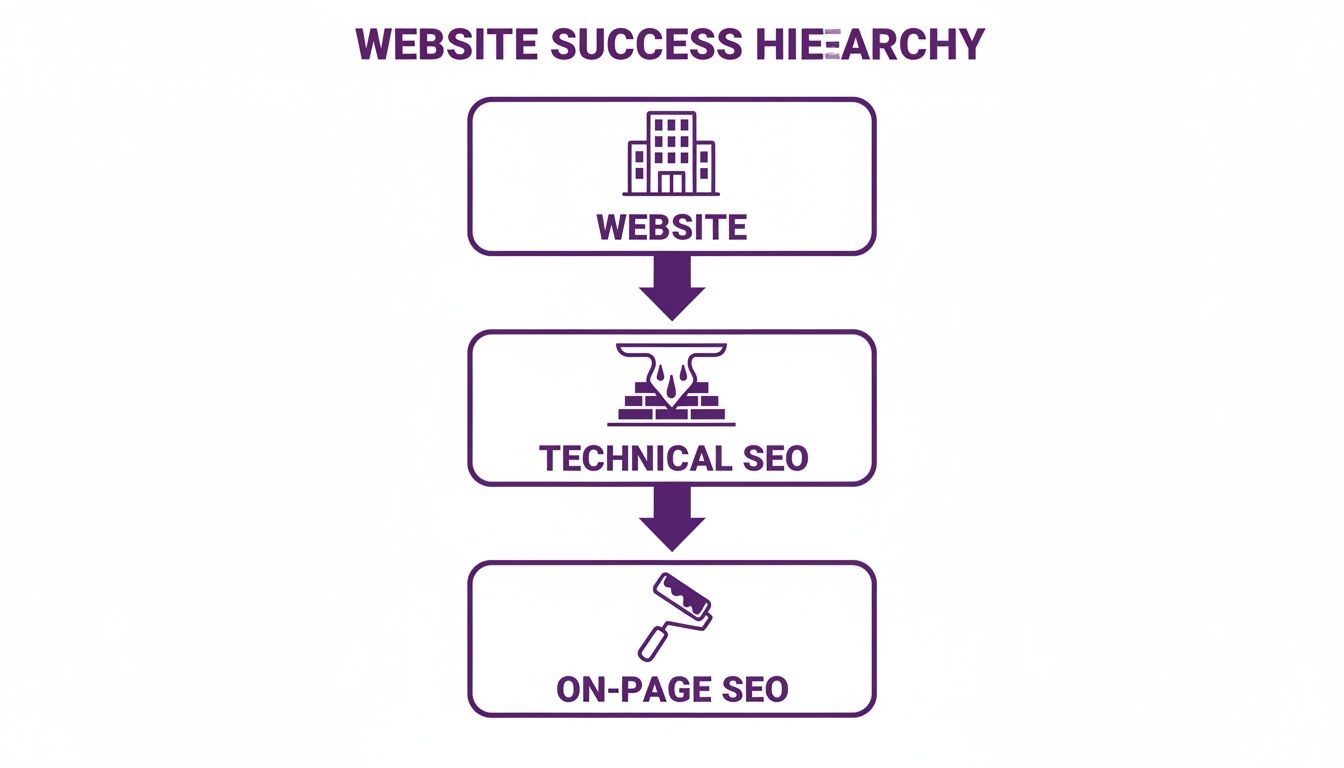
As you can see, without a solid technical base, even the most brilliant content and stunning design will struggle to perform.
Pillar 1: Crawlability And Indexability
Before Google can rank your website, it has to find and understand it first. This is a two-step process:
- Crawlability: How easily can search engine bots (or ‘spiders’) navigate through your site’s pages? If your site has broken links, confusing navigation, or server errors, these bots can get stuck or miss important pages entirely.
- Indexability: Once a page is crawled, Google analyses its content and adds it to its massive database, the index. Only pages in this index can appear in search results. A well-structured XML sitemap acts as a roadmap, ensuring this process is smooth and efficient.
Among the core pillars of technical SEO, learning how to submit an XML sitemap to Google is crucial for efficient site indexing.
Pillar 2: Site Architecture And User Experience
Good site architecture organises your website’s content in a logical, intuitive way for both people and search engines. A clear structure helps visitors find what they need quickly, reducing frustration and keeping them on your site longer.
- Business Benefit: A well-structured website signals quality to Google, which can improve rankings. For users, it simplifies navigation, leading to higher engagement and better conversion rates.
- Australian Example: A financial advisory firm in Brisbane with a logical structure—separating services like ‘Retirement Planning’, ‘Investment Advice’, and ‘SMSF’ into clear sections—helps both clients and search engines understand their areas of expertise.
Pillar 3: Site Speed And Core Web Vitals
In our fast-paced world, speed is everything. A slow-loading website is one of the quickest ways to lose a potential customer. Google uses a set of metrics called Core Web Vitals to measure the real-world user experience of a page, and speed is a major ranking factor.
With over 65% of local searches in Australia now happening on mobile devices, a fast, responsive site isn’t a nice-to-have; it’s essential for capturing leads and driving sales. A delay of even a few seconds can send a potential customer straight to a competitor.
Pillar 4: Mobile-Friendliness
With most potential customers searching from their smartphones, your website must provide a seamless experience on any device. Google now uses “mobile-first” indexing, meaning it primarily evaluates the mobile version of your site for ranking.
A site that is difficult to use on a phone—with tiny text, links that are impossible to tap, or horizontal scrolling—will suffer in search rankings.
- Business Benefit: A mobile-friendly design is crucial for capturing leads from customers on the go, whether that’s a tradie looking for supplies in Sydney or a professional searching for a service during their commute in Melbourne.
Pillar 5: Website Security
Security is a non-negotiable pillar of technical SEO. A secure website, indicated by HTTPS, protects your business and your customers’ data. An SSL certificate encrypts the data exchanged between a user’s browser and your website.
Google Chrome and other browsers actively warn users when a site is “Not Secure.” This warning can instantly destroy trust and send potential leads running. Implementing HTTPS is a fundamental step in building credibility and showing you’re a professional, trustworthy business.
Unlocking an Unfair Advantage with Advanced SEO
Once your website’s core technical foundations are solid, you can implement advanced strategies to gain a serious competitive advantage. These techniques directly tell Google how to interpret your site, making you stand out in a crowded Australian market.

Think of it as adding high-performance parts to an already well-built engine. While the fundamentals keep things running smoothly, these advanced components deliver the extra power needed to win the race for visibility and conversions.
Structured Data: The Cheat Sheet for Google
Structured data (or Schema Markup) is a specialised vocabulary added to your website’s code to explicitly tell search engines what your content is about. It eliminates guesswork and allows Google to display your content in more engaging ways through “rich snippets.”
A Perth-based electrician using schema markup can show up in search results with their 5-star customer rating displayed right under their name. That immediately builds trust and gets more clicks than competitors who just have plain blue links.
To see how this level of clarity prepares your site for the future of AI-driven search, check out our AI SEO Services.
Impact of Structured Data on Search Visibility
This table shows how different types of Schema provide measurable benefits for Australian businesses.
| Schema Type | What It Does | Example Benefit for an Australian Business |
|---|---|---|
| LocalBusiness | Clearly identifies your business type, address, phone number, and opening hours. | A cafe in Melbourne can have its opening hours and location appear directly in Maps and search, making it easier for customers to visit. |
| Review/AggregateRating | Highlights customer ratings and review counts from your website. | A Brisbane-based online store can display its average 4.8-star rating in the search results, instantly boosting credibility and click-through rate. |
| Product | Provides details like price, availability, and brand for individual products. | An online retailer in Adelaide can show the price and stock status for a pair of shoes, attracting buyers with clear commercial intent. |
| FAQPage | Marks up a list of questions and answers on a page. | A Sydney financial advisor's FAQ page can appear as an interactive dropdown in search, answering user questions directly and positioning them as an expert. |
Structured data isn’t just a technical task—it’s a marketing tool that makes your business more visible and appealing at the most critical moment.
Canonicalisation: Preventing Content Confusion
As a website grows, the same content can sometimes appear on multiple URLs, creating a duplicate content issue for search engines. When Google finds the same information at different web addresses, it doesn’t know which one to rank, splitting your ranking power.
Canonicalisation solves this. A simple “canonical tag” points search engines to the one “master” copy, consolidating all ranking signals onto a single, preferred URL and ensuring your SEO power isn’t diluted.
XML Sitemaps: Your Website’s Official Roadmap
An XML sitemap is a file that lists all the important pages on your website, acting as a clear roadmap for search engine crawlers. While Google can find pages by following links, a sitemap guarantees it knows about every page you want it to see.
This is crucial for:
- Large websites with thousands of pages.
- New websites that don’t yet have many external links.
- Sites with rich media like videos and images.
Submitting an up-to-date XML sitemap via Google Search Console leads to faster, more complete indexing, so your new services or blog posts get found and ranked much quicker.
Redirects: Guiding Lost Traffic Back Home
When pages are moved or deleted, you need to guide users and search engines from the old URL to the new one. This is what redirects are for. Without a redirect, users land on a “404 Not Found” error page, and any ranking authority the old page had is lost.
A 301 redirect signals a permanent move, seamlessly forwarding traffic and passing along most of the old page’s ranking power. This simple step preserves your hard-won SEO value and maintains a smooth user experience. Building these advanced strategies into your site is a core part of our SEO and used as appropriate.
Why Australian Businesses Cannot Afford to Ignore Technical SEO
Technical SEO isn’t just about pleasing Google; it’s about building a powerful engine for real, tangible business growth. A technically sound website simply works better for your customers, which translates directly to your bottom line.
When visitors find your site fast, secure, and easy to navigate, they stay longer and are more likely to convert. Google rewards these positive user signals with higher search rankings.

This means more organic traffic and more qualified leads, all without increasing your advertising budget. It’s a strategic investment in sustainable, long-term growth.
The Real-World Impact on Your Business
Let’s look at practical examples for Australian businesses:
- For a Gold Coast tour operator, shaving just two seconds off their page load time could significantly boost online bookings, especially from tourists searching on their phones.
- For a Perth-based law firm, a secure (HTTPS) and mobile-friendly website builds instant credibility, encouraging potential clients to trust them and make that first crucial phone call.
- For a trades business in Melbourne, a well-structured site that Google can easily understand means showing up higher for local searches like “emergency plumber near me,” leading directly to more jobs.
In every case, the website’s technical foundation is directly responsible for generating revenue and building brand authority.
Technical SEO is the difference between a digital business card that just sits there and a high-performance lead generation machine that works for your business 24/7. It’s the framework that makes all your other marketing efforts more effective.
From Visibility to Profitability
Ultimately, the goal is to turn online visibility into profit. Technical SEO bridges that gap. A higher ranking puts your business in front of more potential customers actively searching for your services. A better user experience ensures those visitors convert.
This creates a powerful growth cycle:
- Improved Experience: A faster, more intuitive site keeps users engaged.
- Higher Rankings: Google rewards this engagement with better visibility.
- More Traffic: Higher rankings drive more qualified, organic visitors.
- Increased Leads: A seamless experience converts more of that traffic into enquiries and sales.
Each technical improvement strengthens the next step in the cycle, creating a system for scalable growth. Instead of just hoping for leads, you’re building a reliable, automated pipeline.
How AI is Reshaping the Future of Technical SEO
The rise of AI-powered search is already here, and it’s making a solid technical SEO foundation non-negotiable. Your website now needs to be ‘AI-ready’ to maintain visibility.
AI systems like Google’s Search Generative Experience (SGE) don’t just scan for keywords; they understand concepts and relationships. To generate direct answers for users, they need clean, structured, and machine-readable data. A technically sound site delivers this data with perfect clarity, positioning your business as a trusted, authoritative source for AI to cite.
Making Your Website AI-Ready
To become an authoritative source for an AI, you need a crystal-clear information architecture and entity optimisation. This helps AI understand exactly who you are, what you do, and why you’re a credible expert.
Traditional SEO was about giving Google a map to your website. AI-ready SEO is about giving it a detailed, organised encyclopedia entry about your business—one that’s cross-referenced and easy for a machine to read and trust. This is a key focus of our digital transformation strategies at DigitUX.
The New Competitive Edge for Australian Businesses
For Australian businesses, this shift presents a massive opportunity. Those who stick with outdated technical practices risk becoming invisible. In contrast, businesses that invest in modern, AI-ready technical SEO are building a foundation for long-term success.
By ensuring your website is structured for machine readability, you achieve two powerful outcomes:
- Maintain strong visibility in traditional search results.
- Become a preferred source in the new world of AI-driven answer engines.
This dual benefit ensures your business remains visible and successful for years to come. For a deeper look, discover why partnering with an AI-driven SEO agency is the smart move.
Building Your Powerful Technical SEO Foundation
Technical SEO isn’t an optional extra; it’s the concrete slab your entire digital presence is built on. Get it right, and every other marketing investment—from paid ads to content—works harder and delivers more. The next step is turning theory into action.
Instead of guessing, the smart move is to get a data-driven snapshot of your site’s current health. This allows you to prioritise changes that will deliver the biggest impact on visibility and leads. Think of it like managing technical debt; you proactively fix small issues before they become major structural problems, keeping your most valuable digital asset in top shape.
From Knowledge to Actionable Growth
The goal is to transform your website from an online brochure into an automated lead generation machine. That journey begins with a strategic audit to uncover hidden opportunities in your site’s code and structure.
A strong technical foundation doesn’t just help you rank higher; it builds trust with users, improves conversion rates, and creates a scalable platform for future business growth. It’s the absolute core of a successful digital strategy.
We’ve put together a practical resource to get you started. To begin identifying key areas for improvement, download our free Technical SEO Checklist for Australian Businesses.
For a deeper dive, book a complimentary ‘Technical SEO & Digital Opportunity Audit’ with our team. In this no-obligation session, our Digital Transformation Specialists will provide a clear picture of your website’s performance and pinpoint the most impactful opportunities to help you innovate, automate, and scale.
Your Technical SEO Questions, Answered
Here are common questions we hear from Australian business owners about technical SEO and its impact on their growth.
How Often Do I Need a Technical SEO Audit?
For most Australian businesses, a comprehensive technical SEO audit every 6 to 12 months is recommended. This is sufficient to catch new issues before they impact performance.
However, for large websites, e-commerce stores, or sites undergoing frequent updates, a quarterly check-in is smarter. Think of it as a regular service for a work vehicle; it prevents small problems from becoming major breakdowns and keeps everything running at peak efficiency.
Can I Do Technical SEO Myself or Do I Need an Expert?
While some basics, like submitting a sitemap via Google Search Console, can be handled in-house, the majority of technical SEO requires a specialist. The tools are complex, and a single mistake can seriously harm your rankings.
For example, an error in your robots.txt file could accidentally block Google from your entire website, while incorrect redirects can erase years of built-up SEO authority.
Partnering with a specialist ensures the job is done right the first time, maximising your return and avoiding costly mistakes that could set your business back months or even years.
How Long Does It Take to See Results From Technical SEO?
The timeline depends on the issues identified. Some fixes, like resolving a critical indexing error, can yield positive changes within days or weeks of Google re-crawling your site. Improvements to site speed often have a near-immediate impact on user engagement, such as lowering your bounce rate.
However, the full impact on organic rankings and traffic typically becomes clear over 3 to 6 months. Technical SEO is a foundational investment that builds momentum over time to create a long-term competitive advantage. It’s about building a robust digital asset that performs consistently for years to come.
Ready to build a powerful foundation that drives visibility, leads, and growth for your business? As Digital Transformation Specialists, DigitUX creates strategies that deliver measurable results. Let’s start a conversation about your goals.