


Exceptional ecommerce web design in Brisbane is more than a digital shopfront. It's the engine of digital transformation, designed to increase your visibility, automate operations, and drive measurable growth for your business.
For any Australian business—from professional services and trades to ambitious online retailers—your website must be a strategic asset. It needs to be engineered for peak search performance, high-value lead conversion, and seamless scalability from day one. This guide outlines how DigitUX, as Digital Transformation Specialists, approaches building ecommerce platforms that deliver real business outcomes.
Building Your Ecommerce Foundation in Brisbane
Before a single pixel is placed, a successful online store requires a bulletproof strategy. This isn't just about putting products or services online; it's about defining what success means for your business and architecting the digital ecosystem to achieve it.
This initial planning stage is what connects your investment to tangible results, transforming your website from a cost centre into a revenue-generating asset.
For professional services or trade businesses in Australia, launching an ecommerce platform is a major operational shift. It must be treated as a core business function, not a marketing afterthought. Your strategy here sets the foundation for the entire project and its long-term success.
Define Your Tangible Business Goals
Vague goals like "sell more online" are not a strategy. You need specific, measurable targets tied directly to your operational efficiency and bottom line. This clarity will shape every design, development, and automation decision.
A Brisbane-based trade supplier, for example, might set these actionable goals:
- Increase Average Order Value by 15% by implementing AI-driven product recommendations and targeted upselling at checkout.
- Automate 80% of Tier-1 Customer Enquiries using an integrated knowledge base and an AI-powered chatbot, freeing up support staff.
- Reduce Manual Order Processing by 10 Hours Per Week by fully integrating the ecommerce platform with inventory and accounting systems.
Such targets turn a website from a simple catalogue into a powerful business automation tool. Understanding the complete process of website development for e-commerce is a crucial first step, as it helps align these goals with a realistic project roadmap.
Understand Your Local Brisbane Audience
You must know your customer intimately. Not just their demographics, but their online behaviours and pain points. Are they a tradie on-site searching Google for "same-day delivery fasteners Brisbane"? Or a professional services client researching solutions on LinkedIn during business hours?
Getting this right allows us to craft a user experience that feels intuitive and solves their problem efficiently. For instance, knowing that many Brisbane customers value local expertise can shape your site's messaging and build immediate trust, a key factor in lead conversion.
Conduct a Realistic Competitor Analysis
Analysing your competition isn't about imitation; it's about identifying strategic gaps your business can exploit. Take a hard look at other Brisbane businesses in your vertical and ask critical questions:
- What are their delivery terms and return policies? Can you offer a superior local service, like guaranteed next-day delivery within Southeast Queensland?
- Is their mobile checkout experience clunky? A frictionless, mobile-first design is a common weakness you can capitalise on.
- Are they visible for high-value local search queries? If not, a targeted SEO and AEO strategy can secure a significant first-mover advantage.
This analysis helps you carve out a unique position in Brisbane's competitive digital landscape. The local market is robust, with a large, digitally-savvy population eager to engage with businesses that offer a superior online experience. You can find more data about the booming Brisbane ecommerce market on ideafusionmedia.com.au.
By defining clear goals, understanding your audience, and identifying market gaps, you establish a strategic blueprint. This ensures every dollar invested in ecommerce web design Brisbane is directly tied to efficient, scalable growth from launch.
Choosing the Right Ecommerce Platform
Selecting your ecommerce platform is one of the most critical decisions for your Australian business. It's the architectural foundation for your online sales, customer experience, and the business automations that drive efficiency. Get this right, and you’re poised for scalable growth. Get it wrong, and you'll face frustrating technical debt and operational bottlenecks for years.
For most growth-focused businesses, the choice often comes down to two powerhouses: Shopify and WooCommerce. While both are excellent, they serve different strategic purposes. The right choice depends on your goals for customisation, scalability, and digital transformation.
This is not merely a technical decision; it's a strategic one that must align with your long-term business vision.
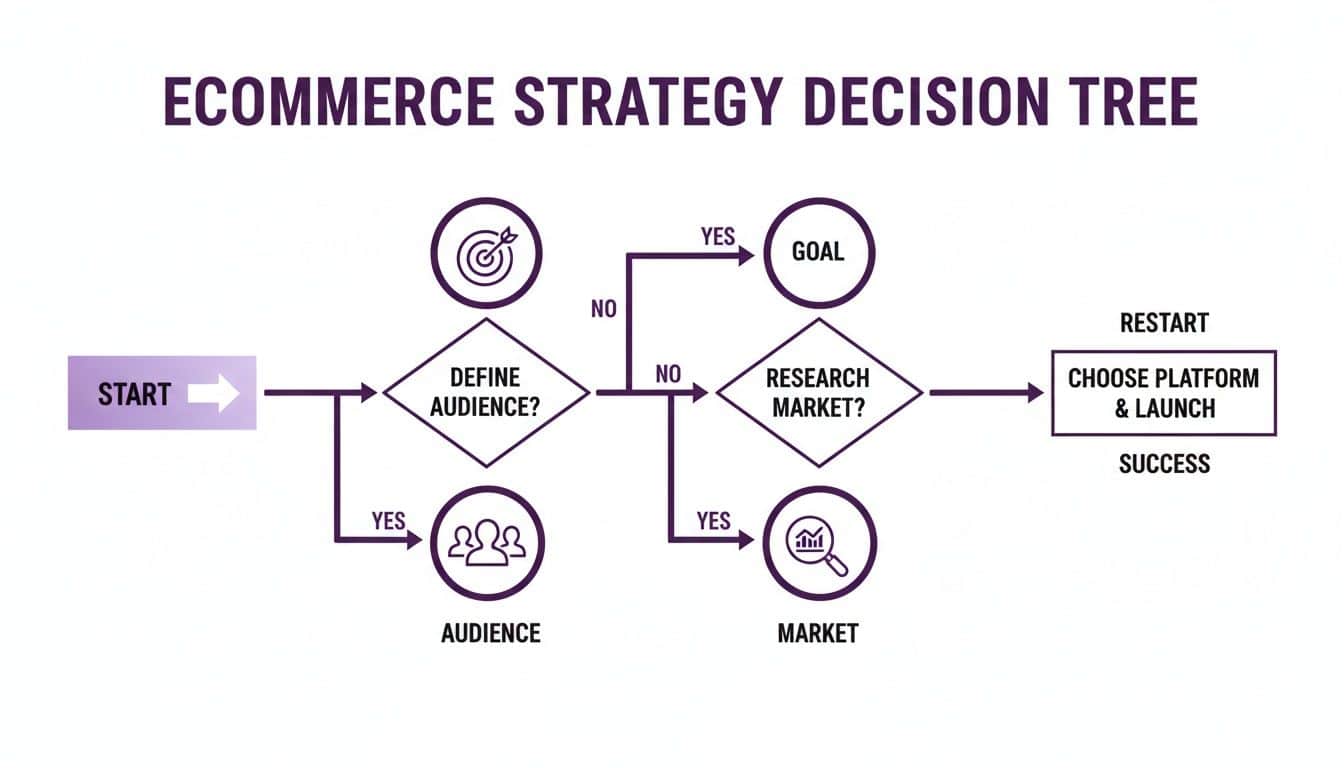
Thinking through these strategic points first will make the platform choice much clearer.
The Case for Shopify
Shopify is a leading SaaS (Software-as-a-Service) platform, renowned for its ease of use and all-in-one nature. As a hosted solution, Shopify manages the technical heavy lifting—hosting, security, and core updates—allowing you to focus on sales and marketing.
It is an excellent choice for businesses prioritising speed-to-market and operational simplicity with a straightforward retail model.
- Integrated Payments: Shopify Payments is ready out of the box and seamlessly integrates with Australian favourites like Afterpay and Zip, which is a major conversion driver.
- Robust App Ecosystem: The Shopify App Store offers a vast range of plug-and-play solutions for everything from loyalty programs to advanced inventory management.
- User-Friendly Interface: The dashboard is intuitive, enabling your team to manage products, orders, and reports without a technical background.
Shopify is perfect for streamlined retail operations. If your goal is to launch a polished, secure online store quickly with minimal technical overhead, its ecosystem is hard to beat.
The trade-off for this simplicity is a degree of control. Transaction fees can accumulate, and customisation is limited compared to open-source alternatives, which can be a constraint for businesses with unique operational needs.
The Power of WooCommerce
WooCommerce is an open-source plugin for WordPress, offering unparalleled flexibility and control. With WooCommerce, you own your entire digital asset—the code, the data, and the hosting environment.
This complete ownership is where WooCommerce excels. It is the ideal platform for businesses with complex product configurations, unique service offerings, or those aiming to build a dominant content and SEO engine alongside their store. If you require a bespoke ecommerce web design Brisbane solution tailored to your precise operational workflows, WooCommerce offers unmatched power.
For businesses focused on deep digital transformation, integrating custom automations and building a unique customer experience, this level of control is essential.
Australian-Specific Considerations
Regardless of the platform, several local factors are non-negotiable for success in the Australian market.
- Local Payment Gateways: Beyond offering Afterpay and Zip, your platform must support Australian gateways like eWay, SecurePay, or Pin Payments if you have specific merchant facility requirements.
- Shipping and Logistics: Seamless integration with Australia Post, Starshipit, or local couriers is critical. This automates live shipping rate calculations, label printing, and customer tracking notifications, which is fundamental for operational efficiency.
- GST and Accounting: The platform must correctly handle GST on all products and shipping. Direct, real-time integration with accounting software like Xero or MYOB is a massive time-saver, eliminating manual data entry and providing an accurate, up-to-the-minute view of your financials.
So, Shopify or WooCommerce? For businesses seeking deep customisation, full data ownership, and the ability to build a powerful, SEO-driven content and commerce engine, WooCommerce is often the superior choice for long-term digital transformation. Learn more by exploring what WooCommerce is in our detailed guide.
Your platform choice dictates your store's potential for scalability, automation, and search visibility. By aligning this decision with your specific business needs and the realities of the Australian market, you build an engine that not only drives sales today but also fuels your growth for years to come.
Designing a High-Converting User Experience
A visually appealing website is merely table stakes. For any serious ecommerce web design Brisbane project, the true measure of success is its ability to convert browsers into high-value customers. This is achieved through the deliberate application of User Experience (UX) and User Interface (UI) design principles, which focus on the psychology of online purchasing.
A great user experience is frictionless. It guides customers intuitively from discovery to checkout, making the entire journey feel simple, trustworthy, and efficient. For Brisbane businesses, this means creating a digital environment that directly addresses the needs and behaviours of a local user.

Crafting Intuitive Navigation and Site Structure
Confusing navigation is the fastest way to lose a sale. Customers expect to find what they need quickly and logically. The goal is a clear information architecture that requires minimal cognitive load, guiding users seamlessly from broad categories to specific products or services.
Consider a Brisbane-based professional services firm. They shouldn't bury their "Business Advisory" services under a generic "Services" menu. It should be a primary navigation item with clear sub-pages like "Strategic Planning," "Financial Modelling," and "Succession Planning." This logical structure not only enhances user experience but also signals topical relevance to search engines, boosting SEO authority.
Designing Compelling Product Pages That Persuade
Your product and service pages are where the final conversion decision is made. They must do more than display information; they must build confidence, address pain points, and create a compelling case for action.
- Professional Visuals: High-resolution imagery and video are non-negotiable. For a Brisbane trade supplier, this means showing a product in use on a worksite, not just a static image on a white background.
- Benefit-Driven Copy: Move beyond technical specifications. Write descriptions that solve a problem or deliver a tangible benefit. Instead of "5000mAh battery," write "All-day power to keep your team connected on-site."
- Social Proof and Trust Signals: Prominently display customer reviews, testimonials, and industry certifications. A staggering 80% of Australian households shop online, and they rely heavily on the experiences of others to validate their purchasing decisions.
For apparel brands, tools like an AI Ghost Mannequin Generator can streamline the creation of high-quality, professional product imagery without the ongoing cost and logistics of photoshoots, a practical example of AI enhancing efficiency.
Building a Frictionless Mobile-First Checkout
With nearly half of all Australians making online purchases via mobile, a flawless mobile checkout is a baseline requirement. The process must be simple, fast, and secure to minimise cart abandonment.
Every additional field, every confusing step, and every second of loading time in your checkout is a potential lost sale. The objective is to remove every point of friction between the 'Add to Cart' button and the final 'Thank You' page.
Key elements of a high-converting checkout include:
- Guest Checkout Option: Never force account creation to complete a purchase.
- Multiple Payment Options: Offer standards like Visa/Mastercard alongside popular Australian choices like Afterpay, Zip, and PayPal.
- Clear Progress Indicators: Show users their exact location in the process (e.g., Shipping > Payment > Confirm).
- Minimal Form Fields: Only request the absolute essential information required to fulfill the order.
Leveraging Data to Drive Continuous Improvement
Your initial design is a data-backed hypothesis, not a final product. True conversion optimisation is an ongoing process of analysing real user behaviour and making iterative, data-driven improvements. Tools like heatmaps, session recordings, and A/B testing provide invaluable insights.
For instance, a heatmap might reveal that users are not engaging with a key call-to-action, indicating its design or placement is ineffective. By A/B testing alternative headlines, button colours, or page layouts, you can gather concrete data on what changes directly improve your conversion rate. This continuous refinement ensures your ecommerce platform evolves, maximises ROI, and stays ahead of the competition.
Mastering SEO and Answer Engine Optimization
A world-class ecommerce website is invisible without strategic search visibility. It’s no longer enough to simply rank on a list of Google links; you must become the definitive answer for your Brisbane customers' queries, whether they are typed into a search bar, spoken to a voice assistant, or processed by an AI engine.
This requires evolving from traditional Search Engine Optimisation (SEO) to the more advanced discipline of Answer Engine Optimization (AEO). The focus shifts from being seen by search engines to being deeply understood by them. This dual approach is essential for any business serious about its ecommerce web design in Brisbane.
Building Authority with Brisbane-Focused Keyword Research
Effective SEO begins with understanding the precise language your local customers use when searching for solutions. This means targeting high-intent, location-specific keywords that signal a clear purchasing need.
For a Brisbane-based professional services firm, broad terms like "business consultant" are too competitive. The real value lies in targeting specific, problem-aware queries:
- "Succession planning advice brisbane"
- "Small business automation specialists"
- "Google Business Profile optimisation service"
These are searches made by decision-makers with a specific problem to solve. By structuring your service pages, case studies, and blog content around these keywords, you attract a highly qualified audience primed for conversion.
The Pillars of Modern Ecommerce SEO
A robust search strategy optimises your website across multiple, interconnected fronts to build authority and drive rankings.
Technical SEO: This is the foundational health of your site. It ensures search engines can efficiently crawl and index your content. Key elements include superior site speed (Core Web Vitals), a mobile-first architecture, and a clean, logical URL structure. A slow, poorly-structured site is penalised by Google and frustrates potential clients.
On-Page SEO: This involves optimising the content users and search engines see. We craft compelling, keyword-optimised title tags, meta descriptions, and service descriptions. This is a blend of art and science—creating content that is genuinely valuable for a human reader while sending clear relevance signals to search algorithms.
Local SEO: For any Brisbane business, this is critical. It involves optimising your Google Business Profile, actively managing local customer reviews, and ensuring your name, address, and phone number (NAP) are consistent across the web. The goal is to dominate the local "map pack" for relevant searches, driving high-quality leads directly to your business.
The Future Is Now With Answer Engine Optimization
While traditional SEO competes for a click in a list of results, AEO aims to become the single, authoritative answer that Google presents directly. This includes coveted positions like featured snippets, "People Also Ask" boxes, and responses delivered by AI assistants like Siri and Google Assistant.
Answer Engine Optimization is the practice of structuring your website’s data so precisely that AI and search algorithms can instantly understand, trust, and repurpose your content. It’s about becoming the source of truth in your niche.
To achieve this, your site's technical structure must be immaculate. This involves implementing structured data (Schema markup) to explicitly label key information like service offerings, business hours, and customer ratings. This makes your data machine-readable, dramatically increasing your visibility in these high-value "answer" formats. You can explore AEO in more detail here to understand how it future-proofs your online visibility.
The opportunity for Brisbane businesses is immense. With Australians spending nearly AU$65 billion online annually, a powerful, modern search strategy is not optional—it's essential for capturing market share. Reviewing the latest Australian ecommerce statistics on firewiredigital.com.au makes it clear: investing in a professional search strategy is a critical business priority.
Integrating Intelligent Business Automation
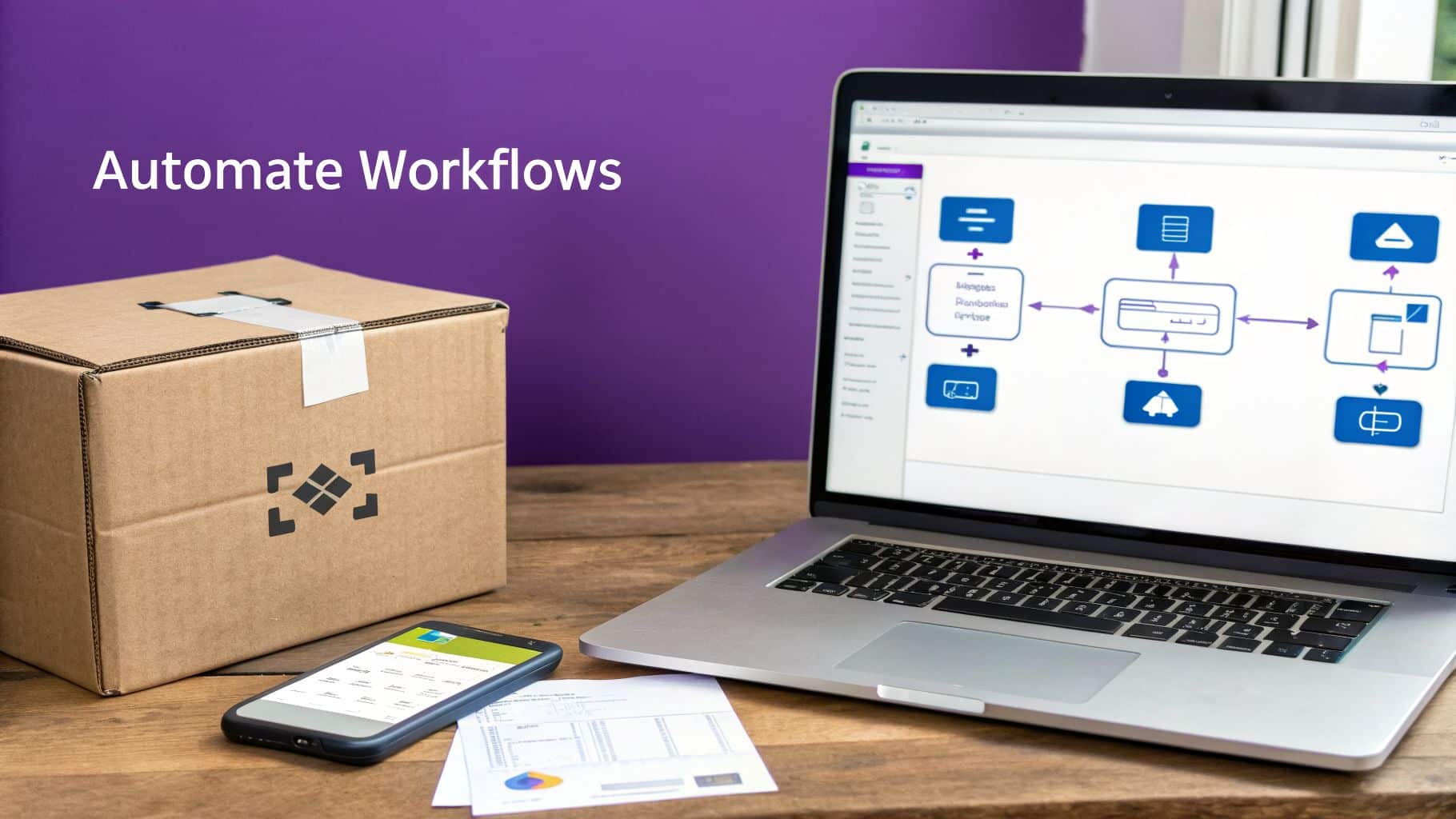
A truly scalable ecommerce business operates with quiet efficiency, driven by a connected digital ecosystem that automates repetitive tasks, saves time, and eliminates costly manual errors. This is where your ecommerce web design Brisbane project transcends a simple website and becomes a core component of your digital transformation.
It’s about engineering intelligent automations that handle the administrative burden, freeing your team to focus on high-value activities like strategy, client relationships, and business growth.
Building Your Connected Digital Ecosystem
The first step is to integrate the essential tools that underpin a modern Australian business. Think of this as creating the central nervous system for your operations, where data flows seamlessly and instantly between platforms without manual intervention.
These integrations are the foundation of an automated system:
- Payment Gateways: Integration with Australian favourites like Afterpay and Zip is essential for meeting customer expectations and maximising conversions.
- Logistics and Shipping: A direct API connection between your store and providers like Australia Post or aggregators like Starshipit is non-negotiable for any business shipping physical goods. It automates everything from rate calculation to fulfillment.
- Accounting Software: This is one of the most significant efficiency gains. Automatically syncing every transaction with your accounting platform, whether it's Xero or MYOB, provides a real-time view of your financial health and eliminates hours of manual reconciliation.
Connecting these foundational systems resolves major operational bottlenecks and sets the stage for more sophisticated automations.
Unlocking Advanced Automation Workflows
The true power of digital transformation is realised when we design custom workflows tailored to your specific business processes. This is where a Digital Transformation Specialist turns your website into the central hub of an intelligent, self-managing system.
These workflows are custom-built sequences of actions, triggered by a specific event, designed to handle repetitive tasks, nurture leads, and deliver a superior customer experience—all on autopilot.
An advanced automation workflow is a competitive advantage. It allows a small team to deliver the sophisticated, personalised service of a large corporation, enabling true scalability and increasing profitability.
Consider these real-world examples for a Brisbane business:
Scenario 1: A Trade Supplier
A new builder applies for a trade account on your WooCommerce website. The moment they click "Submit," a workflow is triggered:
- A new company and contact record is created in your CRM (e.g., HubSpot).
- The contact is tagged as a "Trade Applicant" and added to a specific nurturing sequence.
- A personalised email is sent, confirming receipt of their application and outlining the next steps.
- A task is automatically assigned to your sales manager in your project management tool to review and approve the account.
Scenario 2: A Professional Services Firm
A prospective client downloads a lead magnet (e.g., an industry whitepaper) from your website. The automation begins:
- The contact is added to your CRM and tagged with their area of interest (e.g., "Interest: Business Automation").
- They are entered into a 5-part educational email sequence that provides further value on that topic.
- After the sequence, if they have shown high engagement (e.g., opened all emails, clicked links), a task is created for a consultant to make a personal follow-up call.
These automated sequences ensure that every lead is captured and nurtured effectively, dramatically increasing conversion rates. For a deeper dive into how these systems benefit businesses of all sizes, read more about the rise of business automation in our comprehensive article.
By designing a store with these intelligent workflows from the outset, you are not just building a website. You are building a powerful business asset that generates revenue while creating operational freedom.
Launching and Scaling Your Ecommerce Venture
The launch of your new website is not the finish line—it's the starting grid. A meticulously planned launch and a clear strategy for growth are what distinguish a simple online store from a scalable business asset. This is where your investment in ecommerce web design Brisbane begins to deliver ROI, transforming your digital platform into a powerful sales and lead generation engine.
The launch phase demands precision. A single oversight can result in lost revenue and a poor first impression. A comprehensive pre-launch checklist is non-negotiable for a seamless transition from development to a live, revenue-generating platform.
Your Pre-Launch Checklist
Before announcing your new site to the world, a rigorous final audit is critical. This goes beyond aesthetics to stress-test every functional component, guaranteeing a flawless customer experience from the moment you go live.
Your checklist must include:
- Analytics and Pixel Verification: Confirm that Google Analytics 4 (GA4) and the Meta Pixel are correctly installed and tracking all key conversion events. If you can't measure it, you can't optimise it.
- End-to-End Order and Lead Testing: Conduct multiple test transactions using every payment gateway, including Afterpay and Zip. For service businesses, test every lead form and booking system to ensure data is captured correctly in the CRM.
- Link and Form Validation: Systematically check every link, button, and form on the site. A broken "Contact Us" form is a dead end for a high-value lead.
- Mobile Experience Review: Perform a final, thorough walkthrough of the entire user journey on multiple mobile devices and browsers. With a significant portion of Brisbane's professionals and trades using mobile devices, this experience must be perfect.
A successful launch is an uneventful one. The objective is to identify and resolve any bugs before your customers do. This disciplined approach protects your brand's reputation and ensures your marketing investment is not wasted on a flawed experience.
Fuelling Growth Post-Launch
Once the platform is live and stable, the focus shifts immediately to driving qualified traffic and optimising for conversions. This requires a multi-channel digital strategy designed to place your brand in front of the right audience at the right time.
- Targeted Paid Advertising: Utilise platforms like Google Ads and Meta Ads to execute highly targeted campaigns. For a Brisbane business, this means leveraging geo-targeting to capture local search intent and reach specific professional demographics.
- Content and Email Marketing: Build authority and nurture leads with high-value content that solves your audience's problems. Use marketing automation to deliver personalised email sequences that guide prospects through the consideration process.
- Continuous Optimisation (CRO): Constantly monitor Key Performance Indicators (KPIs) such as conversion rate, customer acquisition cost (CAC), and average order value. This data provides the insights needed to make informed decisions and continuously refine your strategy for improved performance.
A true digital transformation partnership extends far beyond basic website maintenance. It involves ongoing SEO to capture more local market share, conversion rate optimisation (CRO) to enhance profitability, and the evolution of your business automations. This ensures your ecommerce web design in Brisbane not only launches successfully but continues to evolve into an increasingly powerful asset for your business year after year.
Frequently Asked Questions
When embarking on a digital transformation project in Brisbane, several key questions consistently arise. Here are the direct, solution-oriented answers we provide to our clients.
How Much Does an Ecommerce Website Cost in Brisbane?
The cost of a professional ecommerce website is an investment in a revenue-generating asset, and the scope depends entirely on your business objectives. A straightforward Shopify site using a premium template can be an effective starting point. In contrast, a custom WooCommerce solution with deep business system integrations, AI-driven features, and bespoke automation workflows represents a more significant investment in digital transformation.
Our approach is to provide a detailed proposal that maps every cost directly to a business goal—whether it's improving efficiency, increasing lead quality, or driving sales—so you can clearly see the projected return on your investment.
How Long Does It Take to Build an Ecommerce Website?
A typical ecommerce project, from our initial strategy workshop to a successful launch, generally takes between 6 to 12 weeks.
The timeline can be shorter for simpler implementations or longer for complex projects involving extensive custom development, large-scale data migration, or integrations with legacy enterprise systems. We dedicate significant time to the upfront strategy and discovery phase, as this meticulous planning ensures the design, development, and automation stages run efficiently, on schedule, and without costly revisions.
Can You Integrate My Existing Systems Like Xero or a CRM?
Absolutely. This is a core competency and a critical component of any digital transformation project. We specialise in creating robust, two-way integrations between your ecommerce platform and your essential business systems, including:
- Accounting software (Xero, MYOB)
- Customer Relationship Management (CRM) platforms (HubSpot, Salesforce)
- Inventory and Warehouse Management Systems (WMS)
This integration and automation is what unlocks true scalability. It ensures data integrity across your entire operation, eliminates time-consuming manual processes, and empowers your team to focus on strategic growth rather than administrative tasks.
Ready to build an ecommerce platform that drives growth and automates your operations? At DigitUX, we are Digital Transformation Specialists, creating high-performance ecommerce solutions for growth-focused Australian businesses. Contact us today to discuss your project.