


Is your business a high-performance engine? Now, what if you were pouring sludge into the fuel tank every morning?
That’s what manual, repetitive tasks do. The constant invoice chasing, re-entering client data into different systems, and juggling social media posts aren’t just time-wasters; they're the hidden profit killers holding your business back. For Australian businesses in professional services and trades, where every minute is money, these small drags on efficiency are particularly damaging.
At DigitUX, we help growth-focused businesses swap the sludge for premium fuel. As Digital Transformation Specialists, we implement intelligent business automations that reclaim your team's time, enhance your online visibility, and build a scalable foundation for growth.
The Hidden Costs Stalling Your Business Growth
For many Australian businesses, the daily grind of manual work feels normal—it's just "how we've always done it." But these small inefficiencies snowball into significant problems that put a very real limit on your ability to scale and compete. They create an invisible ceiling on your potential, holding you back in ways you might not even realise.
This build-up of repetitive tasks creates a constant drag on productivity. When your skilled tradies or expert consultants are stuck doing admin instead of billable, revenue-generating work, the opportunity cost is massive. It’s not just about the time lost; it's about lost income and missed chances to deliver the exceptional service your clients expect.
The True Price of Doing Things Manually
The fallout from these manual processes sends ripples across your entire operation, leading to tangible—and expensive—issues. These are the tell-tale signs that your business is being held back by operational friction.
Key pain points for Australian businesses we see all the time include:
- Rising Operational Costs: Every minute your team spends on manual data entry, follow-up emails, or pulling together reports is a direct labour cost that adds little value. In a tight market, those costs eat directly into your profit margins.
- Increased Risk of Human Error: Let's be honest, manual data handling leads to mistakes. A single typo in an invoice, a missed appointment, or incorrect client info can cause financial losses, compliance headaches, and serious damage to your professional reputation.
- Team Burnout and Low Morale: Forcing your skilled staff to do mind-numbing, repetitive work is one of the fastest routes to job dissatisfaction. This leads directly to higher staff turnover, which means more hiring costs and the loss of invaluable business knowledge.
At DigitUX, we see Business Process Automation (BPA) not as a complex tech project, but as the strategic solution to these core challenges. It’s about upgrading your engine—a way to get back time, eliminate costly errors, and build a more resilient, scalable business.
Ultimately, these hidden costs are barriers to growth. You can't effectively chase more leads or improve your online visibility if your internal systems are stretched to breaking point. By fixing these foundational issues with smart digital transformation strategies, you create the breathing room your business needs to expand sustainably.
The Six Pillars of Business Process Automation Benefits
Thinking about automation isn’t about flipping a single switch; it’s about rebuilding your business on a stronger, more resilient foundation. This foundation rests on six core benefits. Understanding these pillars clarifies exactly how your business can gain a serious competitive edge. For Australian SMEs, these aren't just buzzwords—they're real solutions to everyday headaches.
The old way of doing things, bogged down by manual tasks, creates a nasty domino effect: wasted time leads to higher costs, which eventually burns out your team and stalls growth.
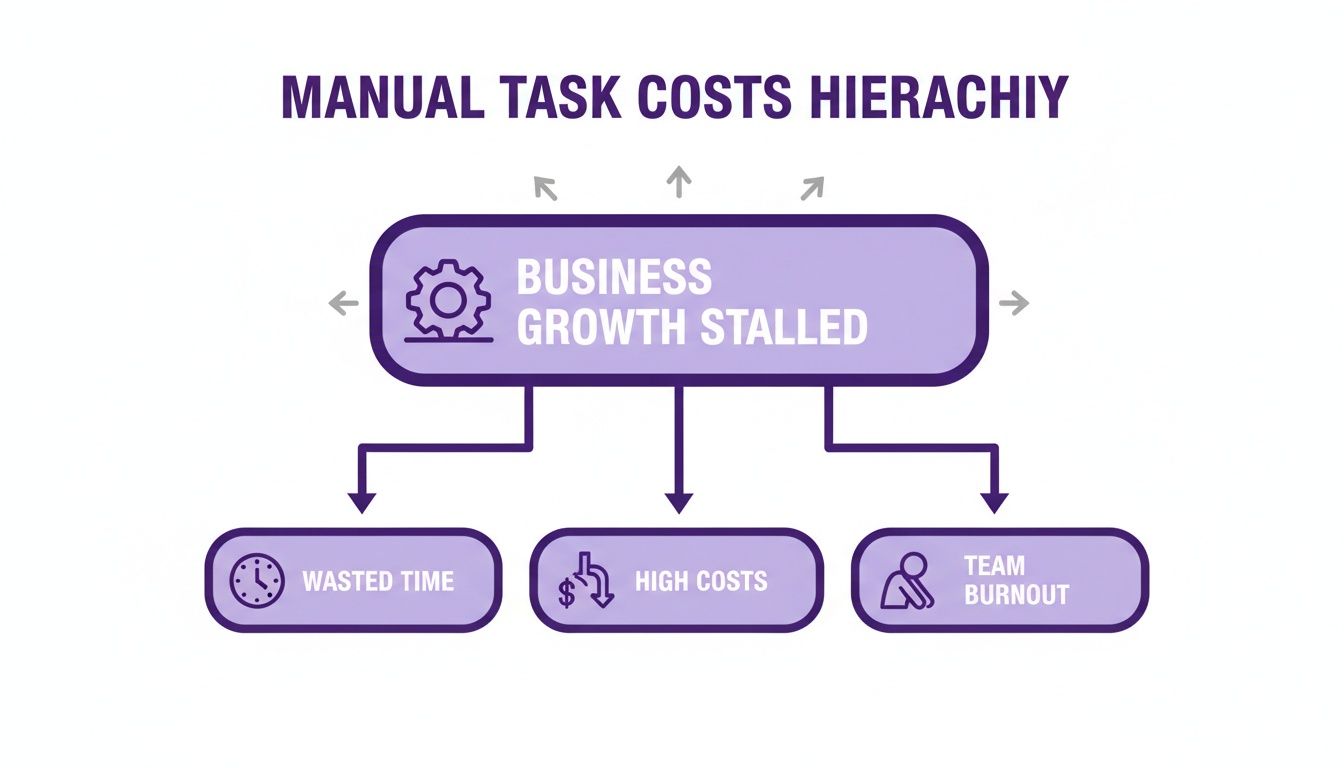
Each of these problems directly eats into your ability to scale. It’s why so many businesses are turning to smarter, automated systems to break the cycle.
To give you a clearer picture, here’s a quick summary of how automation delivers value across different types of Australian businesses.
Core Business Process Automation Benefits at a Glance
| Benefit Category | Description | Example for a Trades Business | Example for a Professional Service |
|---|---|---|---|
| Operational Efficiency | Reclaiming hours by automating repetitive tasks, allowing your team to focus on high-value work. | Automated job scheduling and SMS reminders cut down phone tag and reduce no-shows. | Automated client onboarding that sends welcome packets and collects necessary documents. |
| Cost Reduction | Cutting operational expenses by minimising manual labour, errors, and resource wastage. | Digital timesheets and automated invoicing reduce admin hours and speed up payments. | Automated expense reporting and approval workflows minimise financial admin. |
| Accuracy & Compliance | Enforcing consistency and eliminating human error in rule-based processes. | Automated safety checklists ensure compliance and create a digital audit trail for every job. | Standardised proposal generation ensures all client agreements meet legal requirements. |
| Customer & Employee Experience | Freeing staff from monotonous tasks to focus on client-facing and strategic work, boosting morale and service quality. | An instant quote calculator on the website provides immediate value to potential customers 24/7. | Automated follow-up emails after a consultation keep clients engaged and informed. |
| Scalability & Growth | Handling increased business volume without a proportional increase in administrative overhead. | As you hire more technicians, the automated scheduling system handles the load without needing more office staff. | Growing your client list doesn't require more people to manage billing and reporting. |
| Better Data for Decisions | Centralising clean, real-time data to get a clear view of business performance. | A dashboard showing job profitability in real-time helps you price future work more accurately. | Tracking project milestones automatically gives you a clear view of team capacity and potential delays. |
This table shows how the same core benefits apply in very different settings, solving common growth challenges for both tradies and professional services firms. Now, let’s explore each of these pillars in a bit more detail.
1. Operational Efficiency
At its heart, automation is about getting more done with the resources you already have. It targets the repetitive, soul-crushing tasks that clog up your team’s day, freeing them to focus on work that actually requires a human brain. Think of it as reclaiming lost hours, every single week.
For a Brisbane-based electrical business, this could mean automatically scheduling jobs and sending client reminders. This one simple workflow slashes time spent on the phone, almost eliminates no-shows, and lets your team fit in more jobs per day without hiring more staff. The result is a direct, measurable boost to productivity and revenue.
2. Significant Cost Reduction
Let’s be honest, this is the one that gets everyone’s attention. One of the most compelling benefits of business process automation is its direct impact on your bottom line. Automation cuts costs by reducing the hours your team spends on admin, slashing the expense of human error, and ensuring you’re not wasting resources.
Every manual invoice your team creates, every bit of data they re-enter, and every hour they spend chasing late payments is a real, tangible cost. When you automate these processes, the return on investment isn’t just a number on a spreadsheet—it’s money back in your pocket. These financial gains are the driving force behind the technology's rapid adoption across Australia.
The Australian business process automation market is projected to jump from AUD 638.89 million in 2025 to a massive AUD 1,457.89 million by 2035. That’s not just tech hype; it’s a clear sign that local SMEs are cashing in on huge efficiency gains. Need proof it works at scale? Look at Services Australia, which handled over 468.5 million claims in 2024 using automation. They dramatically cut processing times and errors while managing insane volumes, proving how smart systems can relieve the pressure of repetitive work.
3. Enhanced Accuracy and Compliance
Manual data entry is a ticking time bomb. One misplaced decimal or typo can lead to wrong orders, delayed payments, or even serious compliance breaches. Automation is the antidote, enforcing perfect consistency by taking human error out of the equation for any rule-based task.
Automation ensures the right data is captured and processed correctly, every single time. This doesn't just make your operations more reliable; it builds your professional reputation with clients and partners.
For professional service firms in Australia handling sensitive client data, this is non-negotiable. Automated workflows can ensure regulatory requirements like TFN declarations or client identity verifications are met without fail, creating digital audit trails that make compliance reporting a breeze and reduce the risk of costly mistakes.
4. Improved Customer and Employee Experience
Here’s a simple truth: happy staff create happy clients. When your team is stuck doing monotonous, unfulfilling work, their morale tanks—and your customer service quality often follows. Automation liberates your people from the daily grind, empowering them to focus on more creative, strategic, and client-facing work that they actually enjoy.
For example, understanding the benefits of AI in customer service shows how technology can improve client interactions. An automated system can handle initial client enquiries, qualify leads, and give instant answers to common questions, ensuring customers get a response 24/7. This frees up your team to tackle the more complex issues where their expertise really shines, delivering a higher level of personalised support.
5. Greater Scalability and Growth
How do you take on more clients without your operational costs blowing out? The answer is scalability, and automation is the engine that drives it. Automated systems are built to handle more work without needing more people to manage it.
When your client onboarding, invoicing, and project management workflows run on their own, you can double your client base without doubling your admin staff. This is how you grow sustainably, keeping your profit margins healthy and your service quality high as you expand. It fundamentally breaks the old link between business growth and rising overheads.
6. Better Data for Smarter Decisions
Finally, automation gives you a treasure trove of clean, accurate, and real-time data. Manual processes often leave you with a mess of fragmented information scattered across different spreadsheets and inboxes—most of it inconsistent and out of date. Automated systems centralise everything, giving you a clear, up-to-the-minute dashboard of your business's health.
This reliable data is gold for strategic planning. You can instantly spot bottlenecks, track your most important metrics, and make decisions based on cold, hard facts instead of guesswork. This data-driven approach allows you to fine-tune everything from your Google Ads campaigns to your operational workflows, creating a cycle of continuous improvement. Check out our guide to see how workflow automations can supercharge team productivity and feed this powerful data loop.
Real-World Automation For Australian Businesses
Theoretical benefits are one thing, but seeing automation in action is where its true power really clicks. It’s time to move from concepts on a page to the reality of how these systems solve genuine, everyday problems for Australian businesses, turning manual headaches into smooth, revenue-generating operations. The secret is creating an integrated digital ecosystem where your different tools actually talk to each other.
For most businesses, the journey starts with their online presence. A high-performing WordPress site should be more than a digital brochure; it needs to be the engine room for your lead generation. But what happens after a potential customer fills out a contact form? For too many, it kicks off a clumsy, manual mess. This is exactly where the benefits of automation become tangible.
From Website Lead to Happy Client
Let's walk through a common scenario. A prospective client lands on your website, brought in by your strong Google visibility. They like what they see and fill out your enquiry form. Instead of that form just landing in a crowded inbox, automation takes over instantly.
- The Problem: Leads from the website were getting lost in a chaotic inbox. Follow-up was slow and inconsistent, and manually typing details into the CRM was a time-sucking chore.
- The Automated Solution: An intelligent workflow is built. The moment that form is submitted on your WordPress site, the system automatically creates a new contact in your CRM, tags them as a "new web lead," and assigns them to the right person on your sales team.
- The Measurable Outcome: This simple automation can lead to a 15% lift in lead conversion rates just by ensuring every single enquiry gets a prompt, professional response. It completely wipes out the risk of hot leads going cold.
Intelligent Sales Qualification and Scheduling
Now, let's take it a step further. We all know not all leads are created equal. An AI-powered system can qualify new enquiries from your website or Google Business Profile, making sure your team only spends time on the most promising opportunities.
The system can ask a few simple, automated questions via email or a chatbot to figure out the lead's budget, timeline, and what they need. High-value leads are then automatically sent a link to book a consultation directly into your calendar. Lower-priority enquiries might get a helpful guide or be added to a nurturing email sequence instead.
This isn't about replacing your sales team. It's about giving them a pipeline of pre-qualified, genuinely interested prospects. It transforms their role from chasing maybes to closing deals.
To make this even more powerful, the automation sends calendar invitations and a series of SMS reminders leading up to the appointment. This one simple step has been shown to reduce no-shows by up to 40%, protecting your team's most valuable asset: their time.
Streamlining Operations for a Trades Business
For trades and service-based businesses in Australia, the real bottleneck is often the endless admin. Quoting, scheduling, invoicing, and chasing payments can swallow hours every single day.
Let’s look at a Brisbane-based electrical company as a perfect example of how automation can revolutionise daily operations.
- The Problem: The owner was spending his evenings and weekends creating quotes, manually scheduling jobs, and chasing unpaid invoices. This administrative slog was the single biggest thing stopping him from taking on more work.
- The Automated Solution: A fully integrated system was put in place. Now, a client can request a quote online, which is automatically generated and sent. Once they approve it, the job is added to the schedule, the assigned technician gets notified, and the client receives a confirmation. When the job's done, an invoice is automatically created and sent from their accounting software like Xero or MYOB.
- The Measurable Outcome: The business saw a 30% reduction in administrative tasks, freeing up over 10 hours of the owner's time every week. This allowed him to focus on business development and hire another technician, directly fuelling growth. And when an invoice becomes overdue, the system even sends a series of polite but firm follow-up reminders, improving cash flow without any of those awkward phone calls.
You can dive into a detailed case study of how we transformed a manual onboarding process into a seamless automated one to see these principles in action.
These real-world scenarios prove that the benefits of business process automation aren't just abstract ideas. They are practical, measurable improvements that save time, cut costs, and build a stronger, more scalable foundation for any Australian business ready to grow.
How To Measure Your Automation Return On Investment
Justifying a new business investment can feel like an uphill battle. While the benefits of automation sound great, you need to translate them into dollars and cents to build a solid business case. This is where understanding your Return on Investment (ROI) becomes your secret weapon. It cuts through the noise, turning what feels like a cost into a proven, strategic investment.
The good news? You don't need a finance degree. By tracking a few key metrics before you make any changes, you establish a baseline that makes the financial impact crystal clear.
Key Metrics for Proving Value
To see the real difference automation makes, you have to look beyond just the big-picture numbers. The magic is in the small, operational details that automation touches every single day. These are the Key Performance Indicators (KPIs) that will build the foundation of your ROI calculation.
Start by tracking these core indicators:
- Time Saved Per Task: Measure how long it takes a staff member to do a manual process, like generating a weekly sales report or onboarding a new client. Once automated, multiply the hours saved by their hourly rate for a direct dollar saving.
- Cost Per Lead: If you’re automating parts of your marketing funnel, track what it costs to get a new lead. An automated system for qualifying and nurturing leads almost always brings this number down.
- Error Rate Reduction: Count the number of mistakes that happen in a manual process over a month—think incorrect data entry or invoicing blunders. Figure out the cost of fixing each error, and you'll quickly quantify the savings.
Before you can show how much better things are, you need to know exactly how they are right now. A data-focused table like the one below helps organise the essential metrics you should track before and after implementing automation. It’s the proof you need to show that your investment is genuinely paying off.
Key KPIs for Measuring Automation Success
| KPI | What It Measures | How to Calculate It | Why It Matters |
|---|---|---|---|
| Process Cycle Time | The total time from the start to the end of a specific business process. | (End Time – Start Time) per process. | Shorter cycle times mean faster delivery and improved customer satisfaction. Automation drastically reduces this. |
| Manual Labour Cost | The cost of employee time spent on a specific manual task. | (Time Spent in Hours) x (Employee's Loaded Hourly Rate). | This is the most direct financial saving. Reducing this cost frees up your team for high-value work. |
| Error Rate | The percentage of tasks that contain errors and require manual correction. | (Number of Errors / Total Number of Tasks) x 100. | Lower error rates mean higher quality output, fewer costly fixes, and better customer experiences. |
| Throughput | The number of tasks or transactions completed within a specific time frame. | Total Tasks Completed / Time Period (e.g., per day, per week). | Increased throughput means your business can handle more volume without adding more staff, making you more scalable. |
| Employee Satisfaction | The morale and engagement level of staff involved in the process. | Anonymous employee surveys or direct feedback sessions. | High satisfaction reduces staff turnover, saving you thousands in recruitment and training costs. |
By capturing a 'before' snapshot of these KPIs, you create a powerful baseline. Once your automation is live, tracking these same metrics again will give you the hard data needed to demonstrate clear, measurable improvements and calculate a compelling ROI.
A Simple ROI Calculation for Australian SMEs
Let's put this into practice. Imagine your office manager spends five hours every week manually chasing overdue invoices and reconciling payments in Xero.
If their loaded hourly rate (including super and other overheads) is $45, that one repetitive task is costing your business $225 per week. Over a year, that adds up to a staggering $11,700 spent on a low-value job perfect for automation. An automated invoicing and payment reminder system might only cost a few thousand dollars to set up, delivering a clear and rapid return on investment in just a few months.
This straightforward calculation gives you the evidence you need to make a confident, data-backed decision for change.
Beyond the Numbers: The 'Soft' Benefits That Really Add Up
While the hard numbers are convincing, the true value of automation isn't always captured on a spreadsheet. There are also qualitative benefits—the less tangible but equally powerful improvements—that have a massive impact on your bottom line. These are the advantages that strengthen your company culture and build a more resilient business.
Think about these powerful flow-on effects:
- Higher Employee Morale: When you free your team from mind-numbing work, you reduce burnout and boost job satisfaction. This leads directly to lower staff turnover, saving you thousands in recruitment costs.
- Improved Brand Consistency: Automated communications ensure every client gets the same high-quality, professional experience—from their initial enquiry to their final invoice. This consistency builds trust and strengthens your brand reputation.
- Greater Business Agility: With efficient processes humming along in the background, your business can react much faster to market changes or new growth opportunities. You can scale up to handle more work without your internal systems creaking at the seams.
This is a critical point for Australian SMBs. According to CPA Australia's 2023 Business Technology Report, 25% of businesses increased their investment in automation specifically to fight skills shortages and fill nagging tech talent gaps. By automating routine processes, they became less reliant on manual work, making their operations far more resilient. You can learn more about how Australian businesses are leveraging tech in this detailed report.
This is the power of 'compounding efficiency.' Small, strategic automations don't just add up; they multiply. Each optimised process frees up resources that can then be reinvested into other areas, creating a virtuous cycle of continuous improvement that delivers massive long-term value.
By combining hard data with these powerful qualitative benefits, you can build a complete and compelling case for making automation a central part of your growth strategy.
Your First Steps Into Business Automation
Starting with automation can feel like a massive project, but it doesn't have to be. The trick is to break it down into a clear, manageable plan, turning a daunting task into a series of achievable wins. This is our roadmap for Australian businesses ready to move from idea to action.

This strategic approach ensures your first steps are confident, controlled, and directly tied to your biggest business goals.
Step 1: Identify Your Biggest Time Sinks
Before you can fix a problem, you have to know exactly where it is. Your first job is a simple audit of your day-to-day operations. Get your team together and ask one straightforward question: "What are the most repetitive, frustrating, and time-consuming tasks we do every single week?"
You're hunting for rule-based processes—the kind that follow the same boring steps every single time. The usual suspects include:
- Manually copying client details from a website form into your CRM.
- Chasing up overdue invoices with the same follow-up emails.
- Generating the same weekly or monthly sales reports.
- Scheduling appointments and sending out reminders one by one.
Once you have a list, use a simple 'Impact vs. Effort' matrix to sort them. Plot each task based on how much time it would save (high impact) versus how hard it would be to automate (low effort). Your first target should always be the high-impact, low-effort tasks. These are your quick wins, and they build serious momentum.
Step 2: Choose the Right Tools for the Job
The world of automation software can be overwhelming, but you don’t need a complex, enterprise-level system to start seeing results. The key is to pick tools that play nicely with what you already use, like your WordPress site or accounting software.
For many Australian SMEs, powerful integrator platforms are the perfect starting point. Think of these tools as the "digital glue" that connects your different apps, letting them share data and trigger actions without you lifting a finger. A specialist can help you cut through the noise, ensuring you get a solution that’s powerful enough for your needs but simple enough for your team to manage.
The goal isn’t to replace all your systems. It’s to build a connected digital ecosystem where your existing tools work together seamlessly, eliminating the need for manual data entry and double-handling.
Step 3: Implement With a Pilot Project
One of the biggest mistakes businesses make is trying to automate everything at once. A far smarter approach is to start small with a single pilot project. Choose one of those high-impact, low-effort tasks you found in Step 1 and focus on getting that one process automated perfectly.
This controlled approach lets you:
- Test and Refine: Work out any kinks in a low-risk environment before the automation touches a critical part of your business.
- Build Team Confidence: A successful pilot project proves the value of automation to your staff and gets them excited about what's next.
- Prove the ROI: You can measure the time and money saved from this one project to build a solid business case for doing more.
Once your pilot is running smoothly, you can move on to the next task on your list, building out your automated systems piece by piece. This iterative process is a core principle of successful digital transformation for Australian SMBs.
Step 4: Measure and Optimise for Peak Performance
Automation isn't a "set and forget" deal. To get the maximum benefit, you need to treat it as a continuous cycle of improvement. Once your new workflows are live, go back to the KPIs you set earlier—like time saved per task or error rate—and measure the difference.
This data is your roadmap for what to do next. It will show you what’s working well and shine a light on areas for further fine-tuning. You might discover that a small tweak to a workflow could double its efficiency, or that adding another step could solve a different bottleneck entirely.
The market for this tech is exploding in Australia for a reason. The robotic process automation (RPA) segment alone is projected to skyrocket from USD 118.3 million in 2025 to an incredible USD 1,176.2 million by 2033. This surge is driven by SMEs using accessible platforms to slash costs and boost accuracy, especially in areas like IT operations and document analysis.
By consistently measuring and tuning your systems, you ensure your investment keeps delivering compounding returns, creating a more efficient and scalable business.
Common Questions About Business Process Automation
Even when the benefits are clear, taking that first step towards automation can feel daunting. Lots of Australian business owners we talk to wonder if it’s really the right fit for their size, budget, or team. Let's tackle the most common questions we hear, with straightforward answers to help you move forward with confidence.
Is Business Automation Only for Large Corporations?
Absolutely not. In fact, small and medium-sized businesses (SMEs) often get the most dramatic wins from business process automation. Modern automation tools aren't the clunky, expensive systems of the past; they’re designed to be affordable, scalable, and easy to get started with, levelling the playing field.
Think about an Australian trades business. Just automating appointment scheduling and invoicing can free up dozens of hours every month. That’s time you can pour back into taking on more jobs or improving customer service, letting you compete with the big players without a bigger payroll. The trick is to start small with high-impact automations and build from there.
Will Automation Replace My Staff?
This is probably the biggest fear we hear, but it’s based on a misunderstanding of what automation is really for. The goal isn't to replace your team, it's to empower them. It’s about taking over the tedious, soul-destroying tasks that lead to burnout and giving your people the space to do what they do best.
When you automate the repetitive admin work, you free up your team to focus on what humans excel at: creative problem-solving, strategic thinking, and building genuine relationships with your clients. For most Aussie businesses, automation boosts morale and plugs skills gaps, leading to a more engaged and productive workforce.
How Much Does It Cost to Start Automating?
The initial investment is far more accessible than most people think. Many powerful automations can be built using simple subscription tools that cost as little as $50 to $100 per month.
The real question isn’t "what does automation cost?" but "what is the cost of not automating?" Think about the time, money, and opportunities you're losing each week to manual errors and inefficient processes.
A partner like DigitUX can help map out a phased approach. We focus on delivering a clear, measurable return on your investment, starting with quick wins that often pay for themselves within a few months.
Do I Need to Be a Tech Expert?
Not at all. While the technology behind the scenes can be complex, many of today's best automation platforms have user-friendly, 'no-code' or 'low-code' interfaces. This means you can build powerful workflows without ever writing a line of code. Many businesses explore practical applications like seeing how to build a knowledge base agent to make information easier to find.
However, the real magic happens when you start integrating different systems—like your WordPress website, your CRM, and your accounting software—into one seamless digital ecosystem. This is where a digital transformation specialist comes in. We handle all the technical complexity behind the scenes, making sure everything just works, so you can focus on running your business.
Ready to stop wasting time on manual tasks and start building a more efficient, scalable business? As Brisbane-based Digital Transformation Specialists, DigitUX helps Australian businesses grow with intelligent automation, enhanced online visibility, and strategic digital solutions. Let's discuss a practical roadmap that delivers real results.