

Let's be honest, the terms branding and activation get thrown around a lot, often used interchangeably. But they're two sides of the same coin, and understanding the difference is the first step to building a business that people in Australia remember and love.
So, what’s the simple truth? Branding is who you are—it’s your business’s personality and the promise you make to your customers. Activation is what you do—it's how you bring that promise to life through actions and experiences.
Why Branding and Activation Are Your Business Superpowers
Think of your business strategy like the recipe for a perfect flat white.
Your branding is the carefully crafted recipe itself. It defines the unique ingredients (your values), the flavour profile (your personality), and the promise of a delicious coffee. It’s the soul of what makes your business special.
But a recipe just sitting in a drawer doesn't caffeinate anyone, does it?
That's where brand activation comes in. Activation is the act of actually grinding the beans, pulling the shot, and serving that perfect coffee up to your customers. It’s the tangible, hands-on experience that turns your brand promise from a nice idea into a memorable reality.
For Australian businesses, mastering both the recipe and the delivery is what separates a fleeting success from a beloved local favourite. Without strong branding, your activation efforts are just random marketing noise. Without effective activation, your brilliant brand remains an untold story.
The Formula for Growth
When you nail both—a powerful brand and smart activation—you create an unstoppable engine for business growth. This synergy doesn't just get you noticed; it transforms your business from just another option into a customer's go-to choice.
This flowchart shows how the thoughtful strategy of branding combines with the dynamic energy of activation to produce real, measurable business growth.
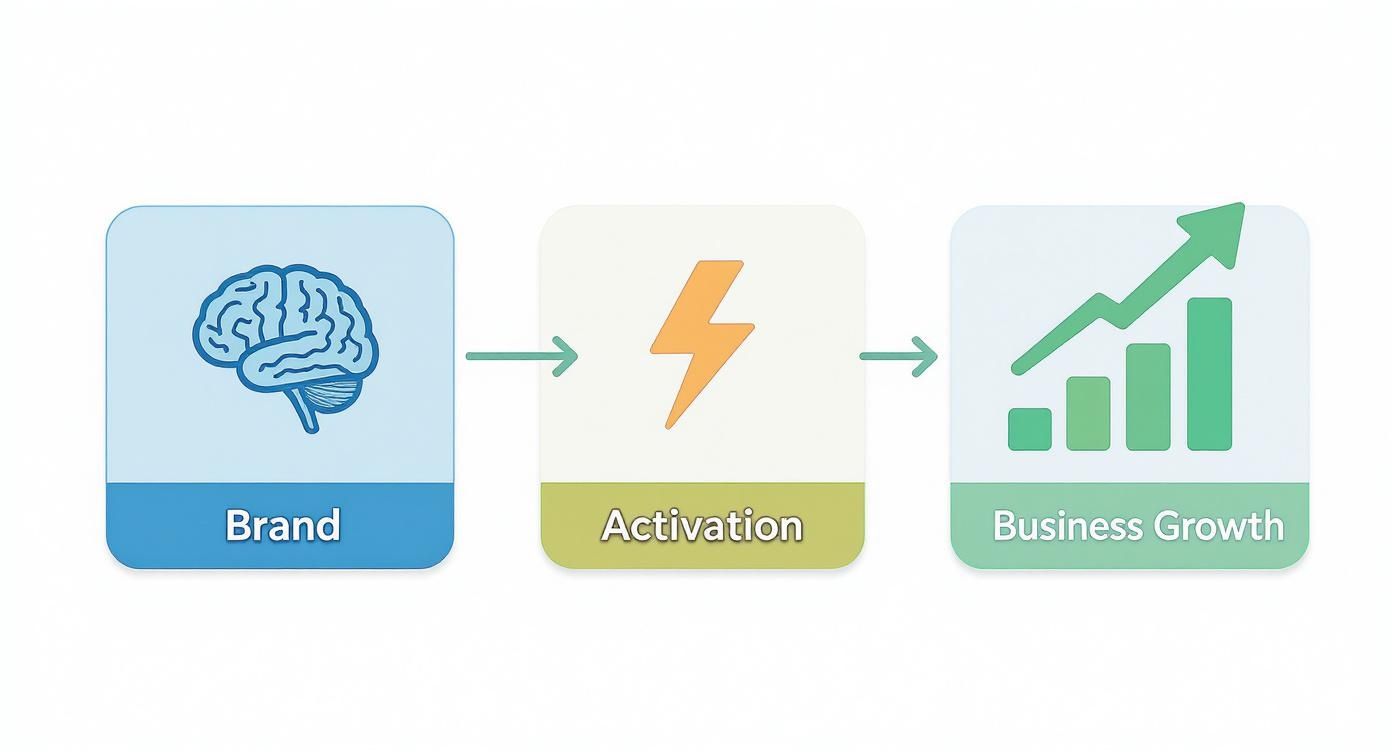
As you can see, one element directly fuels the other. It’s a powerful cycle that strengthens customer relationships and, ultimately, your bottom line.
Building a Memorable Presence
In the crowded Aussie market, having a great product or service simply isn't enough anymore. People are drawn to businesses they feel a genuine connection with.
That connection is built through consistent branding and reinforced every time they have a positive, engaging experience with you—that's activation in action.
A brand becomes stronger when you narrow the focus. The key is to create a clear identity that is easy to remember and instantly recognisable. Your activation efforts should then amplify that single, focused idea.
By aligning your brand’s personality with every single customer interaction, you achieve two critical goals:
- You build trust: Consistency shows customers you’re reliable and that your promise is the real deal.
- You create loyalty: Memorable experiences turn one-time buyers into long-term advocates who do your marketing for you.
This guide will walk you through practical strategies to help your Australian business define its brand and activate it effectively, setting the stage for sustainable growth.
Building a Brand That Actually Connects with Australians
Let’s be real, a slick logo or a catchy tagline isn’t a brand. A real brand is the gut feeling people have about your business. It’s the sum of every tiny interaction, every message they see, and every experience they have with you. For Aussie businesses, forging this connection means building an identity that genuinely clicks with local values and expectations.
This kind of identity doesn't just happen. It's carefully built on a bedrock of clear purpose, consistent messaging, and a distinct personality that shapes everything you do. When you get these pieces working in harmony, you create an authentic brand that customers can actually relate to and, most importantly, trust.

Defining Your Core Brand Components
Before you can bring your brand to life, you need to define its core. This is an inward-looking process, where you establish the fundamental pillars that will steer every business decision you make, from product development right through to customer service.
Think of it as mapping out your brand’s DNA. The core components are:
- Brand Purpose (Your 'Why'): This is your reason for being, beyond just making a profit. What positive impact do you want to have on your customers, your community, or even the world? A great example is Aussie brand Who Gives A Crap, whose purpose is to "make toilet paper that's good for the world".
- Brand Messaging (Your 'What'): This is the consistent story you tell everywhere. It covers your key value propositions, your tone of voice, and the core messages that bring your purpose to life.
- Brand Personality (Your 'How'): This is the human side of your brand. Are you professional and authoritative, or fun and approachable like the team at Koala mattresses? This personality should shine through in every email, social media post, and website interaction.
A strong brand connection always starts with a clear strategy, turning your business vision into its core identity. If you want to go deeper on this, resources on understanding brand strategy through naming can offer some great insights.
The Core Components of a Strong Brand Identity
To make this more concrete, let's break down these pillars and see how they apply in a real-world Australian context. Think of this table as a blueprint for mapping your own brand's DNA.
| Component | Description | Australian Business Example (Coffee Roaster) |
|---|---|---|
| Brand Purpose | Your fundamental reason for being, beyond just turning a profit. | To connect Melbourne coffee drinkers with the world’s best sustainable farmers, ensuring every cup supports ethical practices. |
| Brand Messaging | The consistent story and key messages you communicate. | "Sustainably sourced, locally roasted." Messaging focuses on farmer stories, bean origins, and a deep commitment to the Melbourne community. |
| Brand Personality | The human characteristics and tone of voice your brand embodies. | Authentic, passionate, community-focused, and a bit quirky—like a friendly local barista. The tone is knowledgeable but never pretentious. |
Using this framework, an imaginary coffee roaster like 'Laneway Beans' has a clear guide. Their purpose dictates that they only source from ethical farms. Their messaging ensures their website, packaging, and social media all tell this story. And their personality guarantees their customer service feels as warm and genuine as a chat in a favourite laneway café.
Ensuring Consistency Across All Touchpoints
Once you’ve defined your brand’s core, consistency is everything. Every single place a customer interacts with your business—from your DigitUX-designed website to your Google Business Profile—must reflect the same purpose, messaging, and personality.
Inconsistency is the fastest way to erode trust. If your website feels corporate but your social media is full of memes, customers won’t know who you really are. This confusion weakens your brand and makes it harder to build a loyal following.
By maintaining a consistent identity, you build a brand that is both recognisable and resilient. Customers start to understand what you stand for, which builds the trust you need for a lasting relationship. This is the solid foundation you need before you can move on to the exciting work of brand activation.
Bringing Your Brand to Life with Smart Activation
If your branding is the soul of your business—its personality and promise—then brand activation is how you bring that soul to life. Think of it this way: branding is who you are; activation is what you do. It’s the crucial shift from having a great identity on paper to creating real, tangible experiences that prove your brand promise to your customers.
Effective brand activation is all about crafting memorable moments that let people truly feel and live your brand. This isn't about random marketing stunts; it's a series of strategic, purposeful actions designed to forge genuine, lasting relationships. For Aussie businesses, that means creating touchpoints that resonate just as strongly in the local community as they do online.
From Passive Identity to Active Experience
Let's imagine a local brewery in Perth. Their branding might be built around being "authentically West Australian and adventurous." A great starting point, but right now, it's just an idea. Activation is what turns that idea into a real experience.
So, instead of just running ads that say they're adventurous, they could:
- Sponsor a local surf competition down in Margaret River, handing out free samples to thirsty spectators.
- Host a "Trail & Ale" day, partnering with a local hiking group for a guided walk that finishes with a brewery tour.
- Launch a limited-edition beer using ingredients sourced from the Kimberley, and then tell the story of its origin across their social media.
Each of these actions is brand activation in its purest form. They are tangible proof of the brand’s promise, creating an emotional connection that a simple ad just can't match.
Digital and Physical Activation Strategies
Here in Australia, a winning branding and activation strategy has to blend the online world with offline community engagement. The aim is to create a seamless journey where customers feel connected to your brand, no matter where they first discover it.
Here are a few powerful activation tactics for Australian SMBs:
- Engaging Social Media Campaigns: Go beyond just posting product shots. Run a user-generated content competition asking your customers to share photos with your product in iconic Aussie spots. It creates fantastic engagement and gives you a mountain of authentic social proof.
- Local Community Sponsorships: Putting your name behind the local footy club or setting up a stall at a community market places your brand right in the heart of your target audience in a positive, supportive way. It shows you’re invested in the community you serve.
- In-Store Promotions and Events: If you have a brick-and-mortar location, an in-store workshop, a product tasting session, or a VIP shopping night can create a huge buzz. It transforms your shop from just a place to buy things into a destination.
- Experiential Pop-Ups: A temporary pop-up shop in a high-traffic area like Melbourne's Federation Square or Brisbane's Queen Street Mall can introduce your brand to a massive new audience in a really immersive and unforgettable way.
Effective activation creates a memory. It’s the difference between a customer knowing your brand exists and feeling like they’re a part of your brand's story. This feeling is what builds true customer loyalty.
Investing in Immersive Experiences
Aussie marketers are increasingly putting their money where the experience is, prioritising immersive brand activations. Below-the-line (BTL) marketing activities like pop-ups and in-store events continue to attract major investment. Projections show that by 2026, investment growth will be strongest in experiential events (43%), retail media (41%), and digital amplification (39%). This highlights a clear focus on building stronger consumer connections in both physical and digital spaces.
This trend hammers home a critical point for any business owner: customers want to interact, not just be sold to. The most successful branding and activation efforts are those that invite people to participate and create genuine value for them, long before a sale is ever made. It’s these thoughtful, strategic interactions that turn passive observers into your most active, loyal fans.
Choosing Your Channels in the Australian Market
Once you’ve nailed your brand identity and you get how activation brings it to life, the next question is obvious: where do you actually do it?
Effective branding and activation is all about meeting your customers where they already are. Pouring your budget into the wrong channels is like setting up an amazing farmers market stall in an empty industrial park. The produce might be incredible, but if nobody’s there to see it, it doesn't matter.
For Australian businesses, this means being strategic about who you’re trying to reach. A B2B software company in Sydney will find its audience in a very different place than a direct-to-consumer fashion brand out of Byron Bay. The key is to stop guessing and start analysing where your specific audience spends their time.
The Dominance of Digital and Social Channels
Social media has completely reshaped how Australians discover and connect with businesses. It’s no longer just a place to chat with friends; it's a primary research tool. In fact, over 58% of Australians now use social platforms to research brands, a figure that's nipping at the heels of traditional search engines at 62%. This makes your social media presence a non-negotiable part of your activation strategy.
LinkedIn, in particular, has become the undisputed home for B2B networking and brand building in Australia. Its advertising audience reach shot up by 13% year-on-year, now connecting with 17 million users—that’s over 80% of the adult population.
Choosing Platforms for B2B vs B2C Activation
Different platforms serve different purposes, and a one-size-fits-all approach just doesn't cut it. You need to align your channel with your business model.
-
For B2B Businesses (e.g., IT Consultants, Commercial Builders):
- LinkedIn: This is your primary playground. It’s perfect for establishing thought leadership, sharing industry insights, networking with decision-makers, and running highly targeted ad campaigns based on job titles or company size.
- Email Marketing: This channel is direct, personal, and professional. Use it to nurture leads with valuable content like case studies, white papers, and industry news that proves your expertise.
-
For B2C Businesses (e.g., Cafes, Retailers, Tradies):
- Instagram & TikTok: These visual-first platforms are gold for showcasing products, telling your brand story through video, and running influencer collaborations. They thrive on authentic, engaging content that feels real.
- Facebook: Still a powerhouse for building community and reaching a broad local demographic. It's excellent for running targeted ads, promoting local events, and engaging with a loyal customer base through groups.
Your choice of channel isn't just about reaching people; it's about reaching them in the right mindset. A business owner scrolling LinkedIn is looking for professional solutions. Someone on Instagram is open to visual inspiration and discovery.
The Critical Role of Local Search
For any Australian business with a physical presence or a defined service area, your local online footprint is your single most powerful activation channel. Period.
When a potential customer in Brisbane searches for "best plumber near me" or "coffee shop in Paddington," you have to be the first name they see. This is where an optimised Google Business Profile (GBP) becomes essential. It’s much more than a listing; it’s a dynamic activation tool that directly connects online searches with offline sales. A well-managed GBP with glowing reviews, recent photos, and accurate info can massively increase foot traffic and phone calls.
Optimising for local search is a continuous activation effort. If this is a priority, you should check out our guide on 5 local marketing strategies that you can implement today. These are the tactics that ensure when local customers are ready to buy, your brand is the one they find.
The Nuances of Influencer Collaborations
Partnering with influencers can be an incredibly effective way to activate your brand, but it demands careful selection. The goal isn't just to find someone with a huge following; it's to find a partner whose values and audience genuinely align with your own.
An authentic collaboration feels like a natural recommendation from a trusted friend. A mismatched one feels like a jarring, paid advertisement that everyone sees right through. To effectively reach audiences in the local market, consider using platforms that categorise and track relevant Australian Influencers.
When you're vetting potential partners, look beyond the follower count. Dig into their engagement rates, the quality of comments they receive, and the overall sentiment of their community. The right influencer can introduce your brand to a highly engaged and relevant audience, building trust and driving action far more effectively than any traditional ad ever could.
Using Technology to Amplify Your Activation Efforts
Executing sophisticated branding and activation campaigns doesn't mean you need a massive marketing department. For Australian SMBs, the right technology is a powerful force multiplier, letting you scale your strategies efficiently and punch well above your weight. By getting a handle on a few key tools, you can automate your outreach, personalise the customer journey, and flat-out do more with less.
Modern tech isn’t about adding complexity; it’s about making powerful marketing accessible to everyone. Even simple tools can take repetitive tasks off your plate, freeing you up to focus on the big-picture strategy. This shift empowers you to create the kind of consistent, engaging experiences that once required a full team.
The Power of Automation and AI in Activation
Marketing automation is your secret weapon for efficiency. Think of it as a tireless team member who works 24/7 to nurture leads and engage customers. It’s perfect for things like setting up an automated email welcome series for new subscribers or sending a timely follow-up message after a customer makes a purchase.
Artificial Intelligence (AI) takes this a step further. AI tools can help you brainstorm engaging social media content, analyse customer data to spot trends, or even write the first draft of a blog post. This isn't about replacing people; it's about helping you create higher-quality activation content, faster.
The adoption of these tools is accelerating at a breakneck pace in Australia.
The use of generative AI tools is projected to surge from just 20% in 2023 to 70% in 2025. Over the same period, marketing automation became the top investment priority for 58% of marketers—a massive jump from only 17% in 2023.
This data paints a very clear picture: Aussie businesses are leaning hard on technology to make their marketing smarter and more effective.
Your CRM: The Hub of Customer Interaction
A Customer Relationship Management (CRM) system is the central nervous system of your entire activation strategy. It’s so much more than a digital address book; it’s a living record of every single interaction someone has had with your business.
A good CRM helps you:
- Track the entire customer journey: You can see every touchpoint, from their very first visit to your website to their most recent purchase.
- Personalise your communication: Instead of blasting everyone with the same generic message, you can segment your audience based on their behaviour and interests. This makes your outreach far more relevant and effective.
- Improve customer service: When a customer gets in touch, your team has their entire history at their fingertips, leading to a much better, more informed experience for everyone.
By tracking every interaction, you gain the insights needed to personalise the customer journey at scale. For example, you could automatically send a special offer to customers who haven't purchased in six months, re-engaging them with a timely message that feels personal.
Building an Integrated Tech Stack
The real magic happens when you integrate these tools into a cohesive tech stack. When your website, CRM, and automation platforms are all talking to each other, you create a seamless flow of data that fuels smarter activation. This is where expert guidance on business automations can make a huge difference, connecting all the separate systems so they work in harmony.
An integrated system means a new lead from your website automatically pops into your CRM, which then triggers a personalised email welcome sequence. This kind of hands-off process saves countless hours and ensures no lead ever falls through the cracks. At DigitUX, our web development and automation services are designed to build this exact kind of integrated ecosystem, empowering your business to scale its activation efforts without scaling its workload.
How to Measure What Actually Matters
Throwing money at marketing without a clear way to track its impact is just gambling. True progress comes from knowing what’s working and what isn’t, and that means making data-driven decisions that prove every dollar is pulling its weight. The trick is to measure the right things at the right time.
This isn't about one giant dashboard. It's about splitting your metrics into two connected but distinct buckets. The first tracks the slow, steady build of your brand's reputation—the long game. The second measures the immediate, tangible results from your short-term activation campaigns. Getting this balance right is the only way to see the complete picture of your marketing performance.
Long-Term Branding Metrics
Branding is a marathon, not a sprint. It’s all about building value and shaping how people feel about you over months and years. These metrics are like checking the foundations of a house; they won’t tell you how many people walked through the door today, but they will tell you how strong and stable your brand is in the minds of your customers.
These aren't about instant sales, but they are absolutely vital for sustainable growth. Key branding metrics to keep an eye on include:
- Brand Awareness: How familiar is your target market with your business? You can get a feel for this by tracking direct website traffic, social media mentions, and—most importantly—an increase in branded search terms (that’s when people google your business name directly).
- Customer Sentiment: What’s the general vibe out there about your brand? Keep an eye on online reviews, social media comments, and customer feedback to see if the perception is positive, negative, or just neutral.
- Share of Voice: In the online chatter within your industry, how often is your brand mentioned compared to your competitors? Certain tools can help you measure your presence in these conversations.
These numbers climb slowly, but a steady upward trend is a sure sign you're building a valuable asset that will pay off for years. It confirms that your brand identity is genuinely connecting with your audience.
Measuring your brand is like tracking your fitness. You don’t see results after one trip to the gym, but consistent effort builds real strength and endurance over time. It’s about cultivating long-term health, not just chasing short-term wins.
Short-Term Activation KPIs
While branding slowly builds value, activation is all about driving action right now. These Key Performance Indicators (KPIs) are your direct feedback loop, telling you exactly how a specific campaign is performing at this very moment. They’re transactional, highly measurable, and make calculating a direct return on your investment straightforward.
Essential activation KPIs include:
- Website Conversions: How many visitors are actually doing what you want them to do? This could be anything from filling out a contact form to downloading a guide or making a purchase. You can track this with precision using tools like Google Analytics.
- Lead Generation: How many new potential customers did your campaign bring in? For any business with a sales process, this is a non-negotiable metric.
- Click-Through Rate (CTR): For your digital ads and email campaigns, this tells you the percentage of people who saw your message and were compelled enough to click on it.
- Cost Per Acquisition (CPA): How much did it cost to win one new customer from this campaign? This is the ultimate measure of efficiency.
Tracking these KPIs lets you see what’s hitting the mark and what’s falling flat, allowing you to fine-tune your strategy on the fly. This data-first approach is central to how DigitUX handles SEO and digital marketing, ensuring your budget is always working as hard as possible to deliver results you can actually see.
To make the distinction crystal clear, it helps to see how the metrics for each approach compare side-by-side.
Key Performance Indicators for Branding vs Activation
A comparative look at the metrics used to measure the success of long-term branding efforts versus short-term activation campaigns.
| Metric Category | Branding KPIs (Long-Term) | Activation KPIs (Short-Term) |
|---|---|---|
| Audience Engagement | Social media engagement rate, brand mentions, share of voice. | Click-through rate (CTR), conversion rate, cost per click (CPC). |
| Business Impact | Customer lifetime value (CLV), brand loyalty, market share. | Return on ad spend (ROAS), cost per acquisition (CPA), lead volume. |
| Website Performance | Direct traffic, branded search volume, returning visitors. | Form submissions, downloads, sales transactions, bounce rate. |
| Customer Perception | Net Promoter Score (NPS), customer sentiment analysis, reviews. | Campaign-specific feedback, offer redemption rates, time to convert. |
Ultimately, a healthy marketing strategy needs both. Branding metrics confirm you’re building a strong, resonant identity, while activation KPIs prove your campaigns are efficiently driving the immediate actions your business needs to thrive.
Unpacking Your Branding and Activation Questions
To wrap things up, let's tackle some of the most common questions we hear from Australian business owners. These are the practical hurdles that can slow down momentum, but with clear answers, you can move forward with confidence.
How Much Should a Small Business in Australia Budget for This?
There’s no magic number here, as it really depends on your industry and where you are in your growth journey. A solid starting point is to allocate a percentage of your total revenue. Branding might be a one-off investment to nail your identity, but for activation, a common approach is dedicating 5-10% of your annual revenue to ongoing marketing.
The key is to start with a clear plan and scale what works. Focus on high-impact, low-cost digital activations first—like getting your Google Business Profile humming—before you even think about larger-scale events.
Can I Do Brand Activation Without a Big Marketing Team?
Absolutely. For most Australian SMBs, smart activation is far more about strategy than headcount. It’s better to focus on doing one or two channels exceptionally well rather than spreading yourself thin. Pick the email marketing or social media platform where your customers are actually hanging out and master it.
Partnering with a specialist agency like DigitUX gives you the expertise of a full team for specific campaigns, like an SEO push or a website redesign. It lets you execute professional activations without the overheads of hiring in-house.
What Is the Single Most Important Part of a Campaign?
While every element plays its part, the most critical piece is authenticity. Your activation has to genuinely reflect your brand's core values and what you promise your customers. A campaign that feels disconnected from who you are will only confuse people and could even damage the trust you’ve worked so hard to build.
An authentic activation creates a memorable, meaningful connection. That connection is far more valuable than any flashy but hollow campaign, ensuring your efforts in branding and activation build the kind of loyalty that lasts.
Ready to build a powerful brand and bring it to life with strategic activation? The team at DigitUX combines data-driven marketing, smart automation, and expert branding to help Australian businesses achieve measurable growth. Start your journey with us today.
Article created using Outrank