


In today's competitive landscape, getting more Google reviews isn't just a marketing task—it's a core business strategy. For Australian businesses, a steady stream of positive reviews is the ultimate trust signal, directly impacting your visibility, lead generation, and bottom line. The key isn't a complex secret; it's a system. By optimising your online presence, asking for feedback at the right moment, and making the process effortless, you can turn satisfied customers into a powerful engine for growth.
At DigitUX, we specialise in digital transformation, helping businesses like yours build automated systems that drive real, measurable results. This guide will provide actionable strategies to build a five-star reputation that attracts and converts new customers.
Why Google Reviews Are Essential for Australian Businesses
For any Australian professional service, trade, or growth-focused business, your online reputation is your digital handshake. Before a potential customer in Sydney or a client in Perth decides to contact you, they're online, vetting your credibility. A strong, consistent flow of recent Google reviews is the social proof that tells them you're reliable, professional, and deliver on your promises.
This digital validation is often the deciding factor that makes them choose you over a local competitor. It's the difference between being considered and being contacted.
The Real-World Power of Social Proof
It’s impossible to overstate just how much reviews influence buying decisions in Australia. The data clearly shows that peer feedback is no longer a minor influence—it's a primary driver of consumer behaviour.
This table breaks down how Google reviews directly influence customer trust, search visibility, and ultimately, your bottom line in the Australian market.
| Key Statistic | What This Means for Your Business |
|---|---|
| 89% of Australian consumers read online reviews before making a purchase. | Your online reputation is non-negotiable. The vast majority of potential customers are assessing you online before making contact. |
| This figure climbs even higher in metro areas like Sydney and Melbourne. | In competitive city markets, your review profile is a key differentiator that can win you business and build a stronger local presence. |
| A strong collection of genuine reviews is a powerful local SEO signal. | Google's algorithm interprets positive reviews as proof of a valued, active business, boosting your rank in Maps and local searches. |
This reliance on peer feedback means your Google Business Profile has become one of your most critical marketing assets. A profile with only a few old reviews suggests inactivity or, worse, mediocrity. It fails to build the confidence needed to generate a lead.
A strong collection of genuine reviews is one of the most powerful local SEO signals you can have. It tells Google that your business is active, valued by the community, and deserves to be shown prominently in local search results and on Google Maps.
From Visibility to Conversion: The Business Benefits
The benefits extend far beyond a simple star rating. More positive reviews directly improve your ranking in Google's "local pack"—that valuable map section at the top of local search results. Securing this prime digital real estate translates directly into more website clicks, more phone calls, and more qualified leads.
When you implement a proactive review generation strategy, you unlock tangible business benefits:
- Build Instant Trust: Reviews calm the nerves of new customers and make them feel confident choosing you.
- Increase Local Visibility: Higher ratings and review volume improve your visibility on Google Maps and in "near me" searches.
- Boost Lead Conversion: Social proof from happy customers provides the final nudge prospects need to take action.
- Gain Valuable Feedback: Reviews are a goldmine of operational insights, showing you what you’re excelling at and where you can improve.
Ultimately, mastering your online reputation is a fundamental component of any intelligent digital transformation strategy. To fully understand the mechanics, it's worth exploring a comprehensive guide on Mastering Google Business Reviews. By implementing a repeatable system, you create a growth engine that continuously strengthens your brand.
Optimise Your Google Business Profile to Encourage Reviews
Before asking a single customer for a review, your digital storefront must be immaculate. Your Google Business Profile (GBP) is the online front door to your business. If it appears neglected or incomplete, even your most satisfied customers may hesitate to engage. A fully optimised profile not only looks professional but also builds immediate trust and simplifies the review process for your clients.
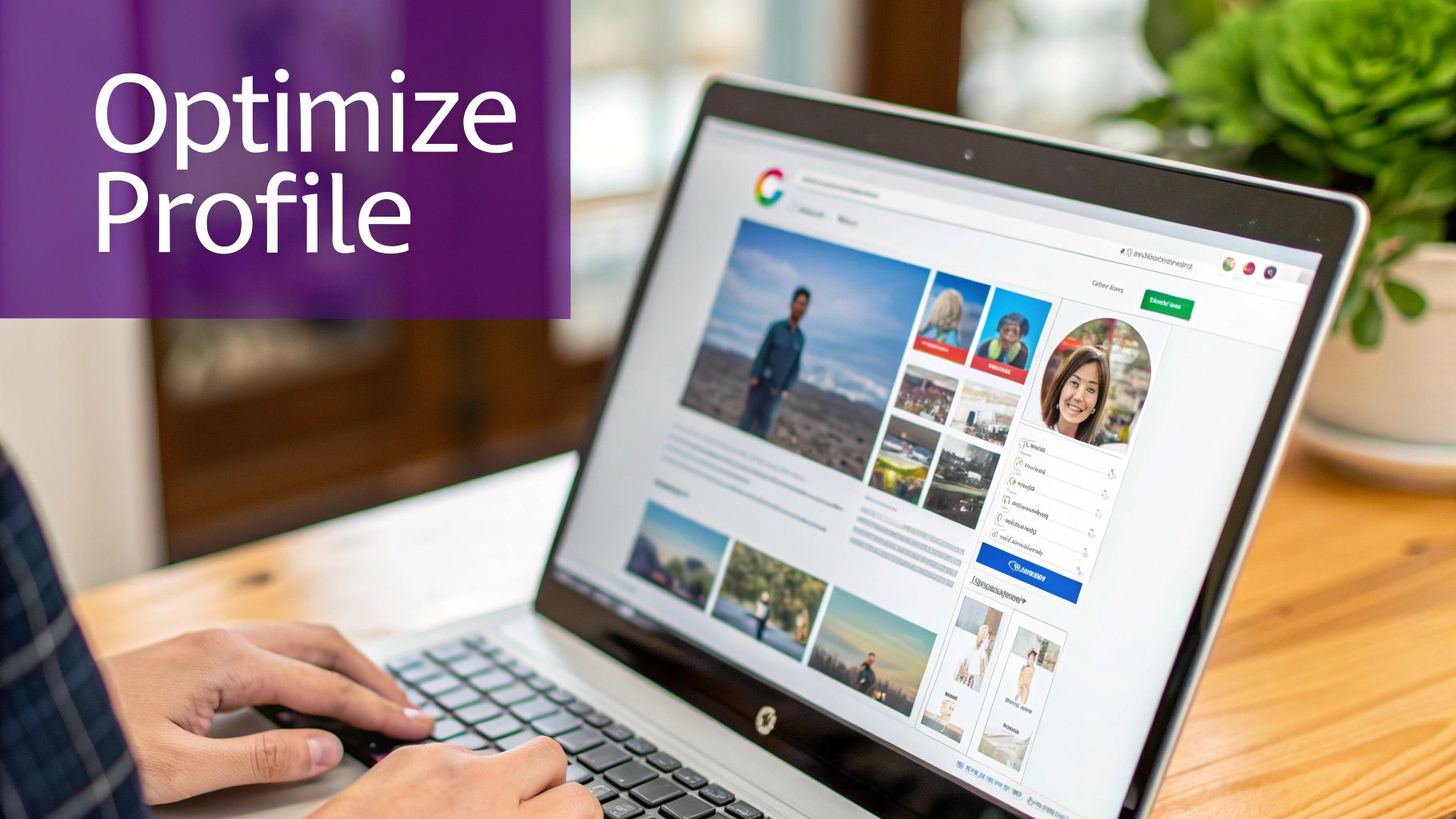
This foundational step signals to both Google and potential customers that you are an active, reputable, and professional operation. When a customer searches for your business to leave feedback, a complete and polished profile reassures them they’ve come to the right place.
Nail the Fundamentals of Your Profile
Getting the basics right is non-negotiable. An incomplete profile creates a significant roadblock for customers and is a simple checklist that many Australian businesses still overlook.
Ensure these core elements are 100% complete and accurate:
- Business Name: Use your exact, registered business name—no keyword stuffing with locations or services.
- Address: Your physical location must be precise to anchor your local search presence.
- Phone Number: List your primary Australian business contact number.
- Website: Link directly to your business homepage.
- Hours of Operation: Keep these updated meticulously, especially for public holidays.
Accuracy is paramount. Incorrect information frustrates customers and sends negative signals to Google's algorithm, which can harm your visibility. A polished profile is the first step in understanding what Google Business Profile optimisation truly entails.
Go Beyond the Basics with Advanced Optimisations
A complete profile is good, but a strategically optimised one is what separates you from the local competition. This is where you can guide potential customers and make your business stand out.
Choose Hyper-Local Service Categories
Don't just select "Plumber." Be specific. Google allows for multiple primary and secondary categories, so use them effectively. For instance, an electrician in Sydney should add categories like "Emergency Electrician North Shore" or "Commercial Electrician Parramatta" if they are relevant. These targeted categories help you appear in more specific, high-intent local searches.
Write a Compelling Business Description
Your business description is your 750-character elevator pitch. Use it to clearly state who you are, what you do, and who you help. Weave in keywords naturally, but keep the focus on the customer. A Brisbane-based accounting firm might write: "We provide expert tax and business advisory services for small to medium businesses across Brisbane, helping you streamline finances and drive sustainable growth."
Leverage the Q&A Feature Proactively
The Questions & Answers section is one of the most underutilised features on GBP. Don't wait for customers to ask questions—pre-empt them. Add your own common questions and provide clear, detailed answers.
By seeding your Q&A section with common queries, you control the narrative and provide instant value. Think about what customers always ask—"Do you offer after-hours call-outs?" or "What areas do you service?"—and answer them yourself. This builds authority and reduces friction for potential clients.
Showcase Your Work with Geotagged Photos
Visuals build trust much faster than words. Regularly upload high-quality photos of your team, your premises, and, most importantly, your completed work.
For a landscaping business in Melbourne, this means posting sharp pictures of a finished garden project in Brighton, with a description mentioning the suburb. Geotagging these images reinforces your local relevance to Google, strengthening your visibility in those specific service areas.
By treating your Google Business Profile as a dynamic asset rather than a static listing, you create a powerful foundation. This attention to detail not only improves your local SEO but also makes customers far more inclined to leave that five-star review.
Mastering the Art of the Review Request
Simply hoping for reviews is not a strategy; it's a path to falling behind. To generate a consistent stream of valuable feedback, you must be proactive and strategic. The art lies in knowing exactly when and how to ask without appearing pushy. It’s about converting a happy customer into a vocal advocate for your brand.
For a plumber who has just fixed a major leak in a Sydney home, that moment of customer relief is a golden opportunity. For a Brisbane business consultant, the ideal time might be a week after delivering a strategy that genuinely impressed the client. You must act when the value you’ve delivered is fresh in their mind.
Timing Is Everything
The single most critical factor in getting more reviews is timing. Ask too early, and it feels presumptive; ask too late, and the positive momentum has faded. Your objective is to identify the "moment of maximum delight" in your customer's journey.
- For Trades and In-Person Services: The ideal time is immediately after the job is completed and the client expresses satisfaction. A simple, "Glad we could sort that out for you! If you have a moment later today, we'd appreciate it if you could share your experience online" is highly effective.
- For Professional Services (Accountants, Consultants, etc.): Ask after a significant milestone or a clear win, such as lodging a successful tax return, finalising a project, or delivering a report that provides obvious value.
- For E-commerce Businesses: Allow customers time to use the product. Sending a request the day of delivery is premature. Wait approximately 7-14 days post-delivery, giving them enough time to form a genuine opinion.
Crafting the Perfect Request
How you ask is just as important as when. A generic, corporate email is easily ignored. Your request should feel personal, be direct, and make the process incredibly simple.
A great request will always:
- Be Personalised: Use their first name. It's a small detail that makes a significant difference.
- Be Direct: Clearly and politely ask for a Google review.
- Explain the ‘Why’: A brief sentence on how their feedback helps your local business (and other customers) can be very persuasive.
- Provide a Direct Link: Never make them search for your profile. Provide a direct link that opens the review submission box.
The most effective requests are concise, sincere, and remove all friction. A simple SMS like, "Hi [Name], thanks again for choosing us. If you were happy with our work, a quick Google review would mean the world. You can leave one here: [Direct Link]" consistently outperforms long, formal emails.
Staying Compliant with Google’s Policies
Building an authentic online reputation requires adhering to the rules. Google is very strict about maintaining the integrity of reviews, and violating their policies can lead to review removal or even profile penalties.
It's critical to know what not to do:
- Never Offer Incentives: You cannot offer discounts, gift cards, or any form of payment in exchange for a review. This is a major policy violation.
- Avoid "Review Gating": This is the practice of selectively soliciting reviews from happy customers while directing unhappy ones to a private feedback form. You must provide everyone with the same opportunity to leave public feedback.
- Do Not Bulk Solicit Reviews: Sending a mass email to your entire contact list requesting reviews can be flagged as spam by Google’s algorithms.
Authenticity is your greatest asset. A profile with hundreds of flawless 5-star reviews can appear less trustworthy than one with a healthy mix of positive feedback and a few constructive comments. In fact, 84% of Australian consumers trust Google reviews as much as personal recommendations from friends and family, cementing their status as the ultimate form of social proof. You can discover more insights about Australian consumer trust on Birdeye.
Making It Effortless for the Customer
The easier you make the process, the more reviews you will receive. Every additional click is a potential drop-off point. A dedicated review landing page can streamline this by getting straight to the point.
For businesses with a physical location—a café in Melbourne, a dental clinic in Adelaide—QR codes are a game-changer. A small sign or card at your counter with a QR code linking directly to your Google review page is incredibly effective. Customers can scan it with their phone and leave feedback on the spot, capitalising on their immediate satisfaction. You can learn more about using QR codes for your small business in our guide.
Automate Your Review Engine for Consistent Growth
Manually requesting reviews from every customer is inefficient, inconsistent, and unsustainable as your business scales. The solution is an intelligent, automated system that handles the heavy lifting, transforming review collection from a sporadic chore into a powerful, self-sustaining marketing engine.
Effective automation isn't about sending robotic emails. It’s about creating personalised workflows that are hands-off for you. By integrating review requests into your existing software—such as your CRM, invoicing platform, or job management system—you can ensure every customer is asked at the perfect moment, every time.
Integrating Review Requests Into Your Workflow
Successful automation links the request to a specific trigger in the customer journey. This makes the request timely and relevant, significantly increasing the response rate. When the ask feels like a natural conclusion to your service, customers are more willing to share their feedback.
Here are a few real-world examples for Australian businesses:
- For a tradie using a job management app: An automated rule could send a personalised SMS 24 hours after a job is marked 'complete', giving the customer time to appreciate the work.
- For a professional services firm: An automated email could be triggered three days after an invoice is paid—a clear signal of a successfully concluded project.
- For an e-commerce store: A follow-up email scheduled 10 days after a product is marked 'delivered' provides enough time for the customer to use their purchase and form a genuine opinion.
This flow chart illustrates what an effective, automated review system looks like in practice.
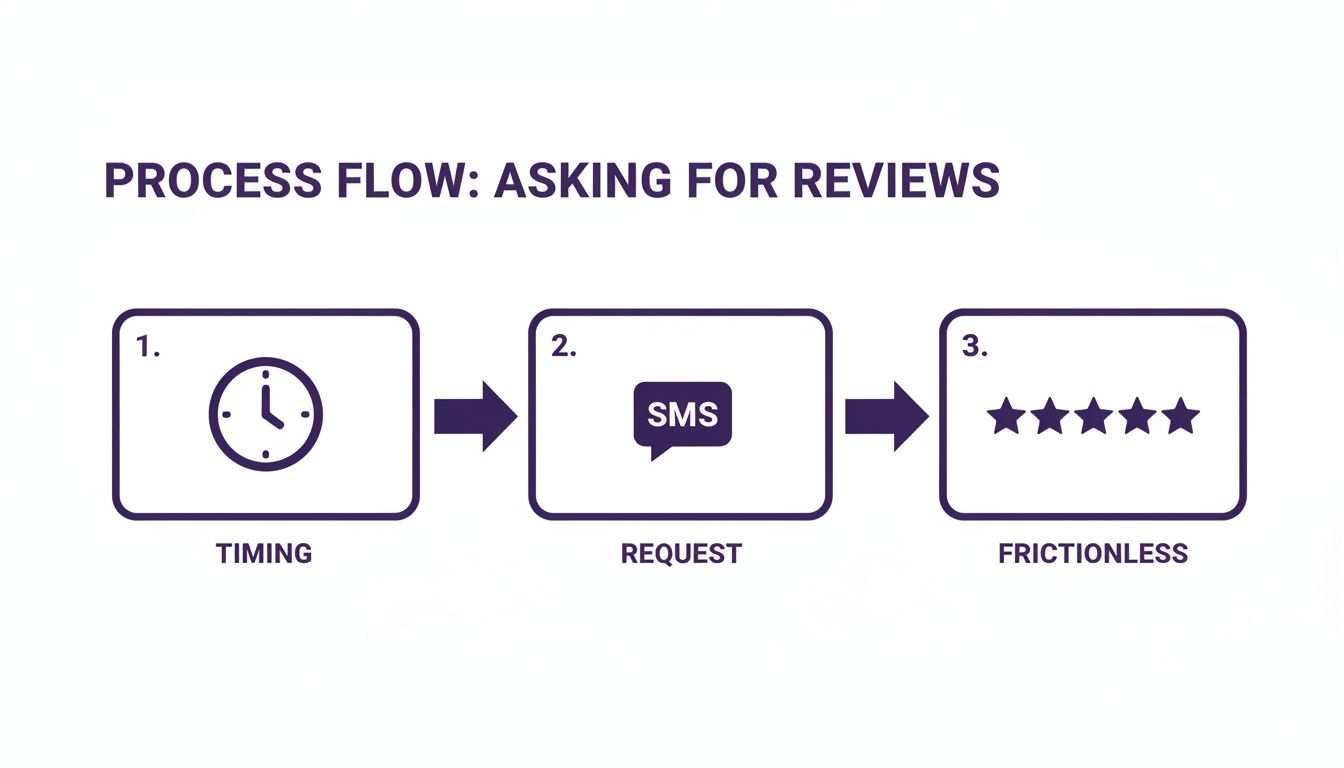
As you can see, success boils down to three key elements: perfect timing, a direct request, and a frictionless customer experience.
Building Your Automation "Recipes"
You don’t need an IT department to set up these automated workflows. Modern tools like Zapier or specialised review management software allow you to connect your applications with just a few clicks. The goal is to build a system that runs silently in the background, consistently feeding your Google Business Profile fresh social proof.
Many Australian businesses have a significant gap between their service quality and their online reputation. This gap represents a massive opportunity for businesses that implement a systematic approach to gathering feedback.
Automation is the great equaliser. It allows a small, agile business to build an online reputation that rivals much larger competitors, simply by being more consistent and systematic in how it gathers customer feedback.
The Benefits of an Automated System
Implementing an automated review engine delivers tangible business benefits that extend beyond your star rating. It is a key component of a modern digital transformation strategy, driving efficiency, visibility, and scalability.
The primary advantages include:
- Increased Efficiency: Free up your team’s time to focus on core business operations instead of manual follow-ups.
- Consistent Results: Ensure no customer is missed, creating a predictable flow of new reviews each month.
- Improved Scalability: Your review system grows with your business without requiring additional manual effort.
- Enhanced Customer Experience: A timely, professional request respects your customer's time and can strengthen the relationship.
By automating this critical process, you are building a system that continuously strengthens your online authority, boosts your local SEO, and generates more qualified leads. It is a foundational step in any serious growth plan. To learn more, explore our guide on the rise of business automation.
Turn Every Review into a Powerful Marketing Asset
Receiving a new Google review is not the end of the process; it's the beginning. Every piece of feedback—positive, neutral, or negative—is a valuable opportunity to engage with customers, showcase your professionalism, and gain operational insights. By responding strategically and repurposing feedback, you can transform a simple star rating into a dynamic marketing asset.

This is more than reputation management; it's about actively using your customers' words to build trust, enhance your local SEO, and create authentic marketing content. By treating your reviews as an ongoing conversation, you demonstrate that you are an authority that genuinely values customer satisfaction.
The Art of Responding to Every Review
A crucial mindset shift: your response is not just for the reviewer. It’s for every potential customer who will read it in the future. A prompt, professional reply demonstrates that you are engaged and attentive, which can significantly influence brand perception.
Responding to Positive Reviews (5-Stars)
Go beyond a simple "Thanks!" Personalise your response by using the customer's name and referencing a specific detail from their feedback. This shows you’ve read and appreciated their comments. For a Brisbane marketing agency, a great response might be: "Thanks so much, Sarah! We're thrilled you found the new website strategy so effective. It was a pleasure working with your team."
Responding to Neutral Reviews (3-Stars)
These reviews are often your most valuable learning opportunities. Thank the customer for their feedback and acknowledge their specific points. Offer to take the conversation offline to resolve their concerns, showing your commitment to improvement and turning a mediocre experience into a positive brand interaction.
Responding to Negative Reviews (1-2 Stars)
A negative review is an opportunity to showcase your professionalism. Remain calm and follow this framework:
- Acknowledge and Apologise: Start by expressing regret that their experience did not meet expectations. Avoid excuses or defensiveness.
- Keep it Brief and Professional: Do not engage in a public argument. Reiterate your commitment to quality.
- Take it Offline: This is essential. Provide a direct contact—a name, email, or phone number—to resolve the issue privately.
A thoughtful response to a negative review is one of the strongest trust signals you can send. It shows prospective customers that even if something goes wrong, you are professional, accountable, and dedicated to making things right.
Amplify Your Best Reviews Across All Channels
Your best reviews are powerful marketing assets. Don't let them sit only on your Google Business Profile. Actively integrate this social proof across your entire digital footprint to build credibility and reinforce your value proposition.
Turn stellar feedback into marketing material by:
- Embedding a Live Review Feed on Your Website: Use tools or plugins for platforms like WordPress to display a dynamic feed of your latest 4 and 5-star reviews on your homepage or service pages.
- Creating Social Media Graphics: Use a design tool like Canva to turn a standout quote from a review into a professional, shareable graphic for LinkedIn, Facebook, or Instagram.
- Featuring Reviews in Proposals and Case Studies: Including a relevant testimonial in a sales proposal can provide the validation a prospect needs to make a decision.
Use Feedback as a Business Improvement Tool
Beyond marketing, reviews offer an unfiltered source of customer intelligence. They provide direct feedback on your services, processes, and team performance. By identifying recurring themes, you can pinpoint areas for operational improvement.
For instance, if multiple reviews praise a specific team member, it's an opportunity for internal recognition. Conversely, if several customers mention confusion with your invoicing process, you know exactly which system requires refinement. This continuous feedback loop is vital for any growth-focused business committed to delivering an exceptional customer experience.
Answering Your Top Questions About Google Reviews
Even with a solid strategy, questions will arise as you focus on building your online reputation. Here, we address the most common queries we hear from Australian businesses, providing a quick-reference guide to navigate challenges on your path to a five-star reputation.
Can I Ask Customers to Specifically Leave a 5-Star Review?
Absolutely not. Directly asking for a 5-star rating is a violation of Google's policies and is considered review manipulation. You should only ever ask customers for their honest, unbiased feedback. The goal is to build genuine trust, and a profile that appears too perfect can seem inauthentic. Focus on delivering exceptional service, and positive reviews will naturally follow.
How Many Reviews Are Enough?
There is no magic number. The two most important factors are consistency and recency. A profile with 100 reviews from three years ago is less persuasive than one with 50 reviews, with several posted in the last month. A steady stream of new feedback signals to Google and potential customers that you are active, relevant, and consistently delivering high-quality work. Focus on creating a consistent flow rather than a specific total.
Aim for progress, not perfection. Instead of fixating on a competitor with hundreds of reviews, focus on building a system that reliably brings in a few new reviews every week. That consistent activity is what truly moves the needle for local SEO and customer trust.
Is It Okay to Remove a Bad Review?
You cannot remove a negative review simply because you disagree with it. Google will only remove reviews that violate its content policies, such as those containing hate speech, spam, or a clear conflict of interest. Instead of trying to delete negative feedback, invest your energy in crafting a professional response. A thoughtful, public reply that addresses the customer's concerns demonstrates accountability and a commitment to satisfaction.
What If My Business Has No Reviews at All?
Starting from zero is a clean slate. Your first step should be to personally reach out to a small, hand-picked group of your most recent, satisfied customers. Contact 3-5 clients with whom you have a strong relationship. Explain that you are building your online presence and ask if they would be willing to share their experience. A sincere, personal request is highly effective for gaining initial traction. From there, you can implement the automated strategies discussed in this guide to build sustained momentum.
At DigitUX, we are Digital Transformation Specialists dedicated to engineering intelligent systems that turn your satisfied customers into your most powerful marketing asset. We build the strategies that increase authority, enhance visibility, and drive sustainable growth for Australian businesses. If you're ready to automate your reputation management and unlock consistent growth, let's talk.