

In a city as competitive as Melbourne, simply having a website is not enough. To attract local customers, your business needs to appear at the exact moment they search for your services. Think “emergency plumber in Richmond” or “best coffee in Carlton”—these are the high-intent searches that drive real business. For any Melbourne business with a physical address or a defined service area, a strategic local SEO plan is no longer a luxury; it’s the foundation of scalable growth.
This is where digital transformation comes in. A sophisticated Melbourne local seo strategy doesn’t just make you visible; it integrates with your operations to attract, convert, and retain customers efficiently. At DigitUX, we specialise in engineering these intelligent systems for Australian businesses.
Why Your Melbourne Business Needs a Digital Transformation Approach to Local SEO
Having a website in a city like Melbourne without local SEO is like setting up a brilliant shop on a quiet backstreet with no sign. You could offer the best service in town, but if local customers can’t find you when they need you most, you’re effectively invisible. This is where a sharp local SEO strategy, as part of a broader digital transformation, becomes your most powerful asset.
Imagine Google as the go-to concierge for every Melburnian. When they ask for the best, closest, or most reliable service, you want your business to be the first name they hear. Local SEO is the work you do behind the scenes to earn that top recommendation, turning your online presence from a hidden gem into a local landmark and a predictable lead generation engine.
Connect with High-Intent Customers
The modern customer’s journey almost always begins with a search engine. In fact, a staggering 46% of all Google searches are from people looking for something nearby. That’s nearly half of all users searching with local intent, ready to walk in, call, or book an appointment.
This represents a huge pool of high-quality leads just waiting for Melbourne businesses to tap into. For tradies, professional services, and local retailers, this is the bedrock of generating a steady stream of enquiries and driving sustainable growth.
Build Trust and Credibility at Scale
Appearing high in local search results does more than just increase visibility; it builds instant trust. When your business appears prominently in Google Maps and the “Local Pack” (the box with the top three results), it acts as a powerful signal to customers. It tells them you are a legitimate, established, and well-regarded local player.
This digital authority is built on several key pillars:
-
Consistent Business Information: Ensuring your name, address, and phone number (NAP) are identical across all online platforms.
-
Positive Customer Reviews: Leveraging social proof to demonstrate your commitment to quality and service.
-
A Professional Digital Presence: A high-performance WordPress website and a fully optimised Google Business Profile that act as your digital storefronts.
By integrating these local SEO tactics into a comprehensive digital transformation strategy, every element works in concert. This unified approach ensures you not only get found online but also convert visitors into loyal customers, creating a scalable system for business growth.
Understanding The Three Pillars of Local Search
To master local SEO in Melbourne, you need to understand how Google thinks. At its core, Google’s only job is to provide the user with the best, most helpful answer to their query. This decision-making process is based on three key pillars: Proximity, Relevance, and Prominence.
Imagine asking a friend for a recommendation for a great local café. They’ll instinctively consider: how close is it to you? (Proximity). Does it serve the type of coffee you like? (Relevance). And is it popular—do other people rate it? (Prominence). Google does the same thing, but with billions of data points.
This concept map shows how these elements connect, linking your physical location, your digital presence on the map, and your online reputation into a cohesive system that drives search performance.
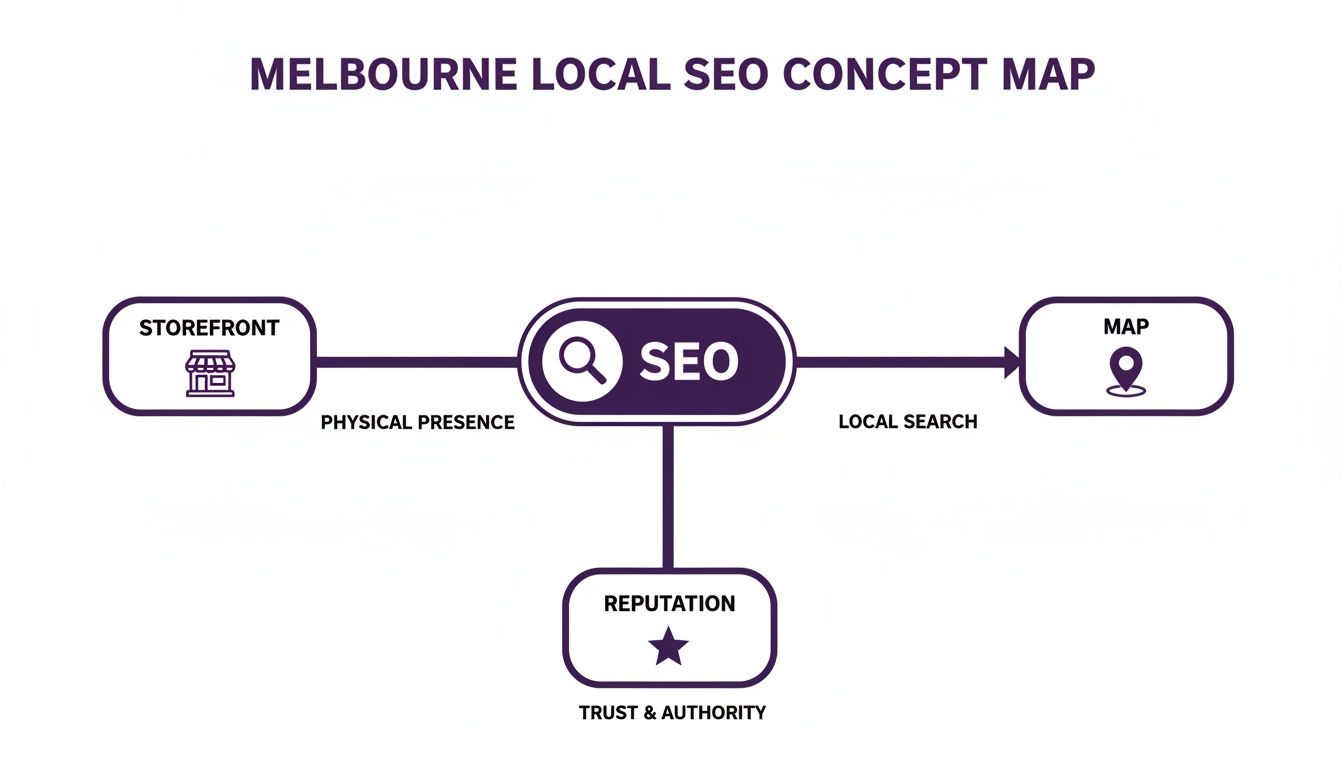
The key insight here is that these elements are interconnected. A strong digital storefront (your website and Google Business Profile) increases your visibility on the map, and a solid reputation provides a massive boost to both.
Proximity: How Close Are You to the Customer?
Proximity is the most straightforward pillar. It answers the user’s immediate question: “How close is this business to my current location?” When someone in Essendon searches for an “electrician near me,” Google’s first priority is to show qualified electricians who are genuinely within a reasonable distance.
While you can’t physically move your business, you can strategically define your service areas. This is crucial for any trade or service-based business that travels to customers across Melbourne. By accurately setting your service area in your Google Business Profile, you tell Google precisely which suburbs you cover, enabling you to appear in searches even if you don’t have a physical address in that specific location.
Relevance: Are You the Right Solution?
Relevance is about matching your business services with a potential customer’s specific needs. It answers the question: “Does this business offer the exact solution I’m looking for?” If someone searches “emergency plumber for blocked drain in Carlton,” Google isn’t just looking for any plumber; it’s scanning for businesses whose online presence specifically mentions these services.
This is where detailed optimisation pays dividends. It’s no longer sufficient to just identify as a “plumber.” You must demonstrate expertise across all your service offerings.
Here’s how to build that relevance:
-
Specific Categories: On your Google Business Profile, choose the most precise primary and secondary categories. For example, use “Plumber” as your primary, but add “Drain Cleaning Service” and “Hot Water System Supplier” as secondary categories.
-
Detailed Service Descriptions: List every service you offer on your website and GBP, using the language your customers use.
-
Content Strategy: Develop blog posts or dedicated service pages that address specific problems, such as a page on “Fixing Leaking Taps in South Yarra.” This signals deep expertise to Google.
Prominence: Are You a Trusted Authority?
Prominence refers to how well-known and respected your business is, both online and in the real world. It answers the final, critical question: “Is this business popular and trustworthy?” A business with a strong digital reputation will almost always outrank a lesser-known competitor, even if they are slightly further away.
Prominence is your digital reputation. It’s the collection of signals that tell Google you are a legitimate, authoritative, and trusted part of the Melbourne business community.
Google measures this through several key signals:
-
Customer Reviews: The number, quality (star rating), and frequency of your Google reviews are powerful trust signals.
-
Local Citations: These are mentions of your business’s Name, Address, and Phone number (NAP) on other reputable Australian websites and online directories.
-
Local Backlinks: A link to your website from another respected local source—like a local newspaper, a community group, or a complementary business—is digital gold.
-
Brand Mentions: Even mentions of your business name without a link can contribute to your local authority.
By systematically building on these three pillars, you provide Google with all the evidence it needs to recognise your business as the best possible answer for local customers. A solid foundation is the key to climbing the rankings in Melbourne’s competitive market and maintaining your position.
How To Optimise Your Google Business Profile
If there’s one heavyweight champion in the local SEO ring, it’s your Google Business Profile (GBP). Think of it as your digital shopfront in Melbourne. It’s your interactive business card, your proof of quality, and for many potential customers, the very first impression they’ll ever have of your business.
A fully optimised profile is your ticket into the coveted “Map Pack”—that box of three local businesses at the very top of Google’s search results. And trust me, that’s where the lion’s share of clicks, calls, and customers are won.
Turning your profile from a simple listing into a lead-generating machine means doing more than just chucking in your address and phone number. It’s about strategically feeding Google every signal possible to prove you’re the most relevant, prominent, and trustworthy choice for someone searching locally.
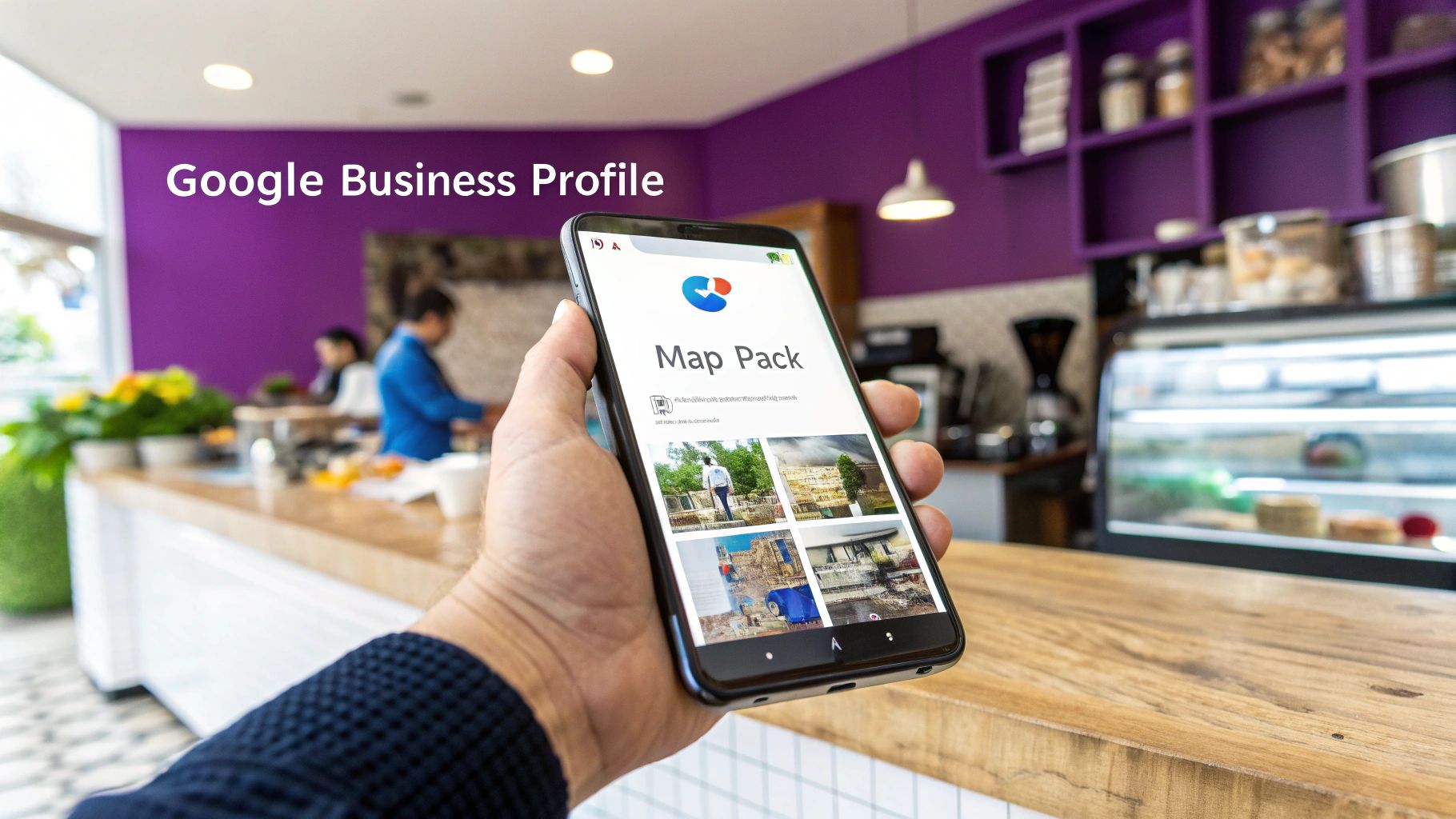
Let’s walk through how to transform your GBP from a placeholder into a powerful tool for dominating Melbourne’s local search results.
Nail The Fundamentals First
Before you even think about the fancy stuff, you have to get the basics absolutely perfect. Accuracy and completeness aren’t just nice-to-haves; they’re the foundation of trust with both Google and your customers.
Start by triple-checking these essentials:
-
Business Name: This must be your exact, real-world business name. Resist the urge to add keywords like “Melbourne’s Best Plumber.” It’s against Google’s guidelines and a fast track to getting your profile suspended.
-
Address and Service Area: Got a shopfront? Make sure your map pin is dropped precisely on your doorstep. If you’re a service-area business, like a mobile mechanic covering the eastern suburbs, define your boundaries accurately. List out the suburbs you serve, like Ringwood, Camberwell, and Hawthorn.
-
Phone Number and Website: Use your main local phone number and link it straight to your website’s homepage. Consistency across the web is absolutely critical here.
Choose Hyper-Specific Categories
This is easily one of the most powerful moves you can make. Google uses categories to figure out what you actually do, so it can show your business to the right people. The key is to be specific, not general.
Don’t just pick “Contractor.” Your primary category should be “Plumber.” Then, layer on secondary categories that nail down your specialities, like “Drain Cleaning Service,” “Hot Water System Supplier,” and “Gasfitter.” This level of detail tells Google exactly what you offer, dramatically increasing your chances of showing up for all sorts of specific, high-intent searches.
Craft Compelling Service Descriptions
Your service descriptions are a golden opportunity to weave in local keywords and show off what you know. Don’t just list what you do—explain the value you bring to your Melbourne customers.
For example, a landscaper could write: “Professional garden design and maintenance for homes across Melbourne’s Bayside suburbs. From turf installation in Brighton to custom deck construction in Sandringham, we transform your outdoor space.” See how that naturally includes both service keywords and local suburbs? That’s what boosts your relevance.
Bring Your Business To Life With Visuals
Photos and videos are your secret weapon for building trust. Customers want to see who they’re hiring and the quality of your work. A profile packed with high-quality, recent photos will always beat a sparse, empty one.
A steady stream of new, geotagged photos sends a powerful signal to Google that your business is active, legitimate, and engaged in the local community. It’s digital proof that you are where you say you are.
Put a solid visual strategy in place:
-
Geotag Your Photos: Before you upload, use a tool to add location data to your images. A photo of a finished roofing job tagged in Essendon reinforces your local connection to that area.
-
Showcase Your Work: Get high-resolution photos of your finished projects, your team in action, and your branded vehicles out on the road.
-
Encourage User-Generated Content: After a job well done, ask your happy customers to upload a photo with their review. Nothing beats authentic social proof.
Actively Manage Reviews and Q&A
Reviews and the Questions & Answers feature are your direct lines to the community. Managing them proactively builds your authority and shapes a positive reputation.
Your goal is a consistent flow of positive reviews. When you finish a job, send the customer a simple, direct link asking for their feedback. And when a review comes in—good or bad—always respond promptly and professionally. It shows you’re listening and that you value their business.
Don’t ignore the Q&A section either. You can get ahead of the game by asking and answering common questions yourself. A local café could ask, “Do you offer gluten-free options?” and then answer it with a detailed list of their offerings. This sorts out customer queries before they even have to ask and lets you control the narrative.
Your Melbourne GBP Optimisation Checklist
To help you pull this all together, here’s a checklist covering the essential and advanced tasks for getting your profile in top shape. Ticking these boxes will put you well on your way to better local visibility.
| Optimisation Area | Action Item | Impact on Ranking |
|---|---|---|
| Core Information | Ensure 100% accuracy for Name, Address, Phone, Website (NAP-W). | High |
| Categories | Select a specific primary category and add all relevant secondary categories. | High |
| Service Details | Add detailed descriptions for every service you offer, including local keywords. | Medium |
| Business Description | Write a compelling, 750-character summary of your business, highlighting what makes you unique in Melbourne. | Medium |
| Photos & Videos | Regularly upload high-quality, geotagged images of your work, team, and location. | High |
| Reviews Management | Actively request reviews from customers and respond to every single one (positive and negative). | High |
| Q&A Section | Proactively seed the Q&A section with common questions and provide detailed answers. | Medium |
| GBP Posts | Publish weekly posts about offers, updates, events, or new services to signal activity. | Medium |
| Products | If applicable, add your key products with high-quality images, descriptions, and prices. | Medium |
| Messaging Feature | Enable the messaging feature and respond to inquiries quickly (within 24 hours). | Low |
| Business Attributes | Select all relevant attributes (e.g., “Woman-owned,” “Wheelchair accessible,” “Free Wi-Fi”). | Low |
Working through this list systematically is the surest way to build a powerful, customer-attracting Google Business Profile that stands out in the competitive Melbourne market.
Building Your Local Authority and Trust Signals
A top-ranking Google Business Profile is a massive head start, but let’s be honest, it’s just one piece of the puzzle. To really own the competitive Melbourne local SEO landscape, you need to build a powerful network of trust signals all over the web.
Think of these signals as third-party endorsements. They tell Google that your business isn’t just a listing; it’s a legitimate, well-regarded, and vital part of the local community. It’s about creating a consistent and authoritative online footprint that screams “prominence.” Every signal you build strengthens your case as the best possible answer for a local’s search.

Mastering Local Citations and NAP Consistency
At the very heart of local authority are citations. Simply put, a citation is any online mention of your business’s Name, Address, and Phone number – what we call your NAP. You can find them in online business directories, on social media profiles, or mentioned in articles. They’re like digital breadcrumbs leading people (and Google) straight to your door.
The single most critical rule with citations is NAP consistency. Your business name, physical address, and main phone number must be identical everywhere they appear online. It’s not a suggestion; it’s a rule.
Little inconsistencies, like using “St” on one site and “Street” on another, or having an old phone number floating around, confuse search engines. This erodes the very trust you’re trying so hard to build.
An inconsistent NAP footprint sends mixed signals to Google. It creates doubt about where you are and how to contact you, which can directly torpedo your local search rankings. A clean, consistent NAP is non-negotiable.
So, where do you start? Get your business listed correctly on the big Aussie directories:
-
Yellow Pages: Still a trusted, long-standing directory in Australia.
-
TrueLocal: A hugely popular platform for finding and reviewing local businesses.
-
Yelp Australia: Widely used for reviews, especially in hospitality and for local services.
-
Industry-Specific Directories: Think hipages for tradies or Healthshare for medical pros.
Your first move should be a citation audit. Google your business name and track down every mention of your NAP you can find. Spot the inconsistencies, hunt them down, and fix them. Make sure every single listing perfectly mirrors the info on your Google Business Profile.
Earning Local Backlinks That Matter
While citations build the foundation, high-quality local backlinks are what will truly set you apart from the pack. A backlink is just a link from another website to yours. When a reputable local website links to you, it’s like a vote of confidence. It passes some of its authority and trust over to your site.
But not all backlinks are created equal. A link from a major Melbourne news outlet carries far more weight than one from a random, unknown blog. The goal is to earn links from sources that are geographically relevant and respected in our community.
These efforts also massively boost your website’s overall Experience, Expertise, Authoritativeness, and Trustworthiness. If you want to dive deeper, check out our detailed breakdown of what E-E-A-T is and why it’s so vital for modern SEO.
Here are a few practical ways to earn backlinks that actually move the needle:
-
Sponsor a Local Community Group or Sports Club: Sponsoring a local footy club in Essendon or a community festival in Fitzroy usually gets you a link from their website’s sponsor page. This is a brilliant signal of genuine local involvement.
-
Partner with a Complementary Business: A plumber in Richmond could team up with a local real estate agent. The agent could write a blog post about “trusted local tradies” and link back to the plumber’s site—a perfectly relevant and powerful backlink.
-
Get Featured in Local Media: Pitch a story idea to a local paper like the Stonnington Leader or a community newsletter. Sharing a unique business story, a community project you’re running, or some expert tips can earn you fantastic media coverage and a quality link.
-
Join Local Business Associations: Becoming a member of groups like the Victorian Chamber of Commerce and Industry often includes a listing in their online directory, which is another great, authoritative local backlink.
Building these trust signals is an ongoing game. By keeping your business info perfectly consistent everywhere and actively chasing high-quality local endorsements, you create a web of authority that Google can’t possibly ignore. This is how you cement your position as a trusted leader in the Melbourne market.
The Future of Local Search AEO and AI
The game of local search is changing. It’s no longer about simply matching keywords; the future is about becoming the most direct, helpful, and authoritative answer to a customer’s question. This is the heart of Answer Engine Optimisation (AEO).
Your goal isn’t just to rank as a blue link anymore. It’s to be the answer itself.
Think about how people search now, especially with voice assistants. A customer in Melbourne isn’t just typing “plumber Richmond” into Google. They’re asking their phone, “Hey Google, find a reliable plumber in South Melbourne who is open now.” To win in this environment, your business has to provide crystal-clear, structured answers that search engines can grab and deliver in an instant.
This is where the technical nuts and bolts of Melbourne local SEO meet the smarts of modern search. By optimising for answers, you’re future-proofing your business and positioning yourself as the most convenient solution, whether that’s in a search result or a direct answer from Google, Siri, or Alexa.
From Keywords to Answers with Structured Data
The secret sauce behind AEO is structured data, often called Schema Markup. It’s a special vocabulary of code you add to your website’s backend. While your human visitors won’t see it, it acts like a set of super-clear labels for search engines.
Imagine your website is a library filled with books that have blank spines. For Google to know what’s inside, it has to read every single page. Structured data is like putting a perfectly printed label on each spine, telling the librarian (Google) the title, author, and genre at a glance.
This lets you spell out crucial business details in a language Google understands perfectly:
-
Your exact services: Go beyond “plumbing” and clearly state you offer “emergency hot water repair.”
-
Your service area: Pinpoint the exact Melbourne suburbs you cover, from Brunswick to Brighton.
-
Your opening hours: Let search engines know precisely when customers can reach you.
-
Customer reviews: Showcase your fantastic star ratings right there in the search results.
When you implement this, you make it incredibly easy for Google to understand who you are, what you do, and why you’re the best answer. For a deeper dive, our guide explains what AEO and GEO are and how they differ from traditional SEO.
Leveraging AI for Smarter Local Operations
Artificial intelligence has moved from a sci-fi concept to a practical tool that can seriously sharpen your local SEO. AI excels at handling repetitive tasks and analysing data on a scale that’s impossible for a human, freeing you up to focus on running your business.
By integrating AI-powered systems, Melbourne businesses can move from reactive marketing to proactive, data-driven operations. It’s about creating an intelligent ecosystem that works for you 24/7, enhancing efficiency and driving growth.
Here are a few ways AI is already changing the game for local businesses:
-
Automated Review Requests: Imagine your invoicing software automatically pings a customer in Hawthorn for a review the moment a job is marked complete. AI can do that, ensuring a steady stream of fresh, positive feedback without you lifting a finger.
-
Competitor Analysis: AI tools can act as your digital spies, monitoring the online activity of your local competitors. You can get an alert when a rival in Camberwell gets a wave of new reviews or starts ranking for a keyword you’re after, letting you react fast.
-
Predictive Analytics: AI can analyse local search trends to see what’s coming. It might spot a seasonal spike in searches for “air conditioning repair in Melbourne’s eastern suburbs” just before a heatwave, giving you a head start on your marketing.
Embracing these technologies isn’t just about keeping up; it’s about building a smarter, more resilient, and more competitive local business for the years to come.
Measuring Your Local SEO Performance
Running a local SEO campaign without tracking the results is like trying to navigate Melbourne’s laneways with a blindfold on. Sure, you’re moving, but are you actually getting anywhere? To make smart decisions, you need to ditch the guesswork and focus on the numbers that actually grow your business. It’s time to forget vanity metrics and measure what really matters.
This data-first approach lets you draw a straight line between your Melbourne local SEO efforts and the real-world impact on your bottom line. When you understand the numbers, you can double down on what’s working, fix what isn’t, and prove the value of every dollar you spend.
Key Metrics That Actually Drive Business Growth
Your two best mates for this job are your Google Business Profile Insights and Google Analytics. They give you a direct window into how local customers are finding and interacting with you online. Instead of getting bogged down in endless reports, zero in on these high-impact performance indicators.
These are the numbers that translate directly into new leads and paying customers:
-
Clicks-to-Call: This one’s a beauty. It shows exactly how many people tapped the “Call” button straight from your GBP listing, signalling immediate intent to do business.
-
Direction Requests: This tracks how many people asked Google Maps for directions to your door. For any business with a physical location, like a café in Carlton or a clinic in South Yarra, this is pure gold.
-
Website Visits from GBP: This tells you how many people clicked from your profile through to your website. It’s a clear measure of how well your GBP is feeding your main sales funnel with qualified traffic.
-
Search Queries: Tucked away in GBP Insights, this list shows the exact words and phrases customers used to find you. It’s an absolute goldmine for understanding how locals think and for sharpening up your keyword strategy.
By focusing on these core metrics, you stop just counting website visitors and start measuring actual leads. Every phone call and every direction request is a potential customer knocking on your door.
Connecting Local SEO to Your Bottom Line
Ultimately, the goal is to tie your local search performance directly to business outcomes. By checking in on these metrics regularly, you can start answering the important questions. Did uploading those new project photos in Essendon lead to more phone calls from that suburb? Is the new service description for “emergency electrical work” actually bringing in more after-hours jobs?
This process turns your SEO from a simple marketing expense into a predictable engine for growth. It gives you the power to make smarter, data-backed decisions that will genuinely scale your Melbourne business.
Your Melbourne Local SEO Questions Answered
When you get down to the nitty-gritty of local SEO, a few questions always pop up. Here are the most common ones we hear from Melbourne businesses, with straightforward answers to help you get moving.
How Long Does It Take To See Results From Local SEO?
It’s the million-dollar question, isn’t it? While quick tweaks to your Google Business Profile can sometimes move the needle in a few weeks, a proper
Melbourne local SEO strategy really starts to deliver noticeable gains in rankings and leads within 3 to 6 months.
Think of it this way: your industry’s competitiveness, your website’s existing reputation, and how consistently you work on it all play a huge part. This isn’t a magic wand; it’s a long-term investment in sustainable growth.
Do I Need a Physical Address in Melbourne To Rank?
If you’re aiming for that all-important Google Map Pack, then yes, a real, verifiable physical address is non-negotiable.
But what about mobile businesses? If you’re a plumber, electrician, or any other Service Area Business (SAB), you don’t need a public-facing shopfront. You can define your service area instead. You’ll still need an address for Google’s verification postcard, but you can choose to hide it from your public profile. This is the key to ranking in the suburbs you serve without needing a traditional bricks-and-mortar location.
Is Local SEO a One-Off Task or an Ongoing Process?
Local SEO is absolutely an ongoing process. I often tell clients to think of it like tending a garden – you can’t just plant the seeds and walk away. Your online presence needs constant attention to flourish.
Google’s algorithm is always changing, new competitors will appear, and your online reputation needs continuous nurturing. Regular activities like acquiring new reviews, publishing Google Posts, and building local links are essential to maintain and grow your local visibility over time.
This consistent effort is what separates the businesses that hit the top and stay there from the ones that get a temporary boost and then fade away. It’s all about building lasting authority in Melbourne’s competitive market.
Ready to transform your local visibility from a business expense into a powerful growth engine? The team at DigitUX are Digital Transformation Specialists, engineering advanced SEO and automation strategies that deliver measurable results for Australian businesses. Book your obligation-free strategy session with DigitUX today.